There is an undeniable, visceral moment when you hold a truly exceptional leather accessory. It is not merely the smooth, cool touch of an unblemished calfskin tote, the distinct, woody aroma of vegetable-tanned bridle leather, or the satisfying mechanical click of an engineered palladium clasp. It is the palpable sensation of human intention. Long before an iconic handbag, a structured attaché, or a minimalist card case arrives beneath the gallery lighting of a flagship boutique, it existed as raw, organic material—unpredictable, demanding, and inherently imperfect.
In an era dominated by rapid synthetic production, automated heat-bonding, and aggressive trend cycles, genuine leather craft stands apart as one of the few remaining bastions of authentic luxury. Yet, the word “leather” has undergone a peculiar dilution in the modern market. Department store shelves and digital storefronts are saturated with items bearing ambiguous stamps like “Genuine Leather,” “Handcrafted,” or “Made in Europe,” obscuring the vast gulf between mass-produced, chemically masked hides and the peerless artistry of centuries-old ateliers.
Understanding the craft of luxury leather accessories requires peeling back these marketing narratives. It demands a journey through the historical tanneries of Tuscany, the specialized cutting tables of Parisian master leatherworkers (maroquiniers), and the precise metallurgy of bespoke hardware. Whether you are an aspiring collector looking to build an enduring wardrobe, a connoisseur seeking to refine your eye for artisanal detail, or simply curious about the quiet disciplines that justify a four- or five-figure price tag, mastering the mechanics of leather craftsmanship changes how you view material luxury forever.
This comprehensive exploration takes you behind the atelier doors. You will uncover the physiological secrets of raw hides, decode the complex alchemy of traditional tanning, examine the microscopic differences between hand saddle-stitching and automated production, and discover how to inspect an accessory with the exacting eye of a master craftsman.
Anatomy of the Hide: The Biological Blueprint of Raw Luxury
Every masterpiece of leatherwork begins not in a design studio, but in nature. To understand why one bag holds its structural silhouette for three decades while another sags, cracks, and peels within eighteen months, one must first understand the biology of the skin.
A mammalian hide is fundamentally composed of collagen protein fibers woven in a three-dimensional lattice. However, this lattice is far from uniform across the animal’s body, nor is it uniform across the cross-section of a single cut.
+-------------------------------------------------------------------+
|  FULL GRAIN (Epidermis/Grain Layer) - Tightest, highest density   |  <-- Pristine surface, natural pores
+-------------------------------------------------------------------+
|  CORRECTED GRAIN / TOP GRAIN        - Sanded, painted/embossed    |  <-- Uniform look, lower longevity
+-------------------------------------------------------------------+
|  CORIUM / JUNCTION LAYER            - Transitional fiber zone     |
+-------------------------------------------------------------------+
|  SPLIT LEATHER / SUEDE / "GENUINE"  - Loose, porous, low tensile  |  <-- Weakest fiber structure
+-------------------------------------------------------------------+
The Stratigraphy of Skin
When a raw hide is prepared, its cross-section reveals distinct biological tiers:
- The Full Grain (Grain Layer): This is the uppermost layer, positioned immediately beneath the hair. Here, the collagen fibers are packed at their highest biological density. The natural pore structure, subtle character lines, and innate resilience remain entirely intact. Full-grain leather has not undergone sanding, buffing, or heavy synthetic coating to remove natural imperfections. Because the grain remains undisturbed, it boasts extraordinary tensile strength, unmatched breathability, and the unique ability to develop a rich, luminous patina over decades of handling.
- The Top Grain (Corrected Grain): When a hide possesses surface scars, insect bites, or uneven pigmentation, industrial tanneries sand away the pristine full-grain surface. They then apply a coat of resin, polyurethane, or pigment and mechanically press a uniform artificial grain pattern onto the surface (such as an artificial pebbled or saffiano texture). While top-grain leather can be durable and stain-resistant, it lacks the biological integrity, softness, and patina potential of untouched full grain.
- The Split (Genuine Leather / Suede): Once the upper grain layer is sliced away on a splitting machine, the loose, fibrous lower layer—the corium—remains. In commercial fashion marketing, this is frequently labeled as “Genuine Leather,” a term that technically confirms the material was once an animal hide, yet functionally denotes the weakest, most porous, and least durable fraction of the skin. Without the structural integrity of the tight upper grain, split leather must be heavily saturated with chemical binders and polyurethane coatings to mimic fine leather.
- Suede and Nubuck Nuances: It is crucial to distinguish between split suede and nubuck. While suede is created by buffing the interior split layer of the hide (yielding a soft, velvety, but structurally lighter nap), nubuck is created by lightly sanding the outer full-grain surface. Nubuck retains the formidable fiber density of the grain layer while offering an ultra-soft, velvety hand-feel, making it vastly superior in durability to ordinary split suede.
Topography of the Cut: Why Pattern Placement Dictates Longevity
A hide is not an interchangeable roll of fabric. A master cutter (coupeur) treats every hide as a geographic map with varying zones of strength, stretch, and softness:
- The Bend or Butt: Located across the lower back and rump of the animal, this is the most prized, dense, and uniform portion of the hide. The fibers are oriented tightly, with minimal directional stretch. Master artisans reserve the butt for high-load areas: structural exterior panels, heavy-duty handles, and structural base components.
- The Shoulder: Slightly more supple than the butt, the shoulder features a firm fiber weave accompanied by natural “neck wrinkles” or growth marks. In luxury leather goods, shoulders are frequently employed for flaps, interior gussets, and structured straps where flexibility must balance rigidity.
- The Belly and Flank: As the hide moves toward the underbelly and legs, the fiber structure becomes loose, spongy, and highly elastic. In cheap mass production, brands cut corners by utilizing belly leather for structural panels, resulting in bags that warp, bubble, and lose their shape over time. In high-end ateliers, belly leather is either discarded entirely or relegated to non-structural interior reinforcement tests.
The Alchemy of Transformation: Vegetable Tanning vs. Modern Metallurgy
Raw animal skins decompose rapidly without intervention. Tanning is the biochemical process of displacing the water molecules within the collagen matrix and bonding the protein chains with specialized tanning agents, permanently arresting decay and imparting pliability.
While modern global production relies overwhelmingly on rapid chemical shortcuts, luxury accessories derive their distinct personalities from centuries-old, highly demanding tanning disciplines.
+------------------------+------------------------------------+------------------------------------+
| CRITERION              | VEGETABLE TANNING                  | CHROME TANNING (MINERAL)           |
+------------------------+------------------------------------+------------------------------------+
| Time Required          | 30 to 60+ days                     | 24 to 48 hours                     |
| Primary Active Agent   | Natural plant tannins (Bark/Wood)  | Chromium (III) sulfate salts       |
| Aroma Profile          | Deep, sweet, earthy, woody         | Faint chemical / neutral           |
| Structural Feel        | Firm, sculptable, high density     | Supple, drapey, uniform softness   |
| Patina Evolution       | Dramatic, darkens with oils/light  | Minimal (static color over time)   |
| Water Sensitivity      | Susceptible to water spotting      | Highly water & stain resistant     |
| Environmental Footprint| Biodegradable, organic waste       | Heavy metal management required    |
+------------------------+------------------------------------+------------------------------------+
The Millennia-Old Discipline of Vegetable Tanning
Dating back to antiquity and refined over generations in regions like Tuscany (under the strict oversight of the Consorzio Vera Pelle Italiana Conciata al Vegetale) and traditional British tanneries, vegetable tanning relies exclusively on organic tannins derived from the bark, wood, fruit, and leaves of trees such as chestnut, mimosa, quebracho, and oak.
The process is remarkably slow. Hides are suspended in an escalating series of pits containing tanning liquors of increasing strength over a period spanning four to eight weeks. The plant tannins slowly saturate the deepest collagen fibrils, binding with the proteins without disrupting their natural orientation.
- The Resulting Character: Vegetable-tanned leather possesses a characteristic firmness, an organic, earthy fragrance, and an open pore structure that breathes. It responds dynamically to its environment. As it encounters sunlight, ambient humidity, and natural oils from your hands, it undergoes oxidation and burnishing, evolving a deep, glossy caramelization known as patina. A vegetable-tanned briefcase or portfolio does not degrade with age; it chronicles the life of its owner.
- Bridle and Saddle Leathers: A specialized subset of vegetable tanning involves “hot stuffing” or currying, where hides are deeply nourished with natural waxes, tallows, and oils. English bridle leather, originally developed for equestrian gear that had to withstand human sweat, torrential rain, and extreme tensile stress, represents the pinnacle of this craft. Its smooth, waxy surface and structural density make it practically indestructible.
The Chromium Revolution and Modern Mineral Tanning
Invented in the mid-19th century, chrome tanning utilizes chromium (III) sulfate salts. It revolutionized the global leather industry by compressing a two-month tanning cycle into less than twenty-four hours.
- The Performance Profile: Chromium tanning yields leather that is exceptionally soft, lightweight, and pliable from day one. It possesses high thermal stability, resists water staining, and readily accepts bright, vibrant aniline and semi-aniline dyes that would be impossible to achieve with the naturally amber-tinted vegetable extracts.
- The Luxury Application: While low-grade chrome tanning dominates mass-market goods, elite luxury houses frequently employ ultra-refined chrome and semi-vegetable tanning techniques for delicate items. The buttery, slouchy lambskins seen in high-fashion evening clutches, the scratch-resistant treated calfskins of modern totes, and the vibrant pastel cardholders of French fashion houses rely heavily on specialized, highly controlled mineral-tanning methodologies.
Combination and Box Calf Tanning
To capture the best of both worlds, master tanneries employ combination tanning—often starting with a chrome bath for suppleness and tensile strength, followed by vegetable retanning (re-tannage) to impart body, edge-burnishing capability, and an elegant firmness.
A legendary historical example is Box Calf (Boxcalf), a black or deep navy calfskin tanned with chrome salts, nourished with specific emulsions, and ironed to create a fine, silky micro-grain. Immortalized by classic mid-century hand luggage and bespoke Oxford shoes, authentic Box Calf possesses a crisp, mirror-like depth that modern mass-market leathers cannot replicate.
Sourcing and Selection: The World’s Elite Tanneries and Terroirs
Just as fine wine is inextricably linked to the terroir of its vineyard, the world’s most luxurious leather accessories depend entirely on the provenance of their raw hides. A luxury house does not purchase commodity hides on the open bulk market; they maintain generational partnerships with, or directly acquire, the planet’s most elite tanneries.
The European Alpine Advantage
The finest calfskins in the world originate primarily from the alpine regions of France, Germany, Switzerland, and Northern Italy. The rationale is biological and geographic:
- Absence of Parasites: The cooler high-altitude climates naturally minimize biting insects such as warble flies and ticks, which leave microscopic scar tissue and pinholes across the surface of the skin.
- Fencing and Pasture Management: Alpine cattle are frequently raised in meticulously managed pastures or indoor environments without barbed wire, preventing the deep scratches that disqualify hides from full-grain luxury status.
- Diet and Growth Rates: Controlled nutrition ensures steady, balanced growth, producing calfskins with microscopic pore sizes, exceptional elasticity, and remarkably uniform tensile strength across the entire surface.
+----------------------------+-----------------------+-------------------------------------------------+
| HISTORIC TANNERY           | REGION / COUNTRY      | SIGNATURE SPECIALTY LEATHERS                    |
+----------------------------+-----------------------+-------------------------------------------------+
| Tanneries Haas             | Alsace, France        | Barenia Calf, Novonappa, Fine Dress Calf        |
| Tanneries d'Annonay        | Ardèche, France       | Box Calf, Vocalou, French Dress Shoe Calf       |
| Tannery Dupuy              | Auvergne, France      | Chèvre Chagrin, Epsom-type Embossed Calf        |
| Horween Leather Company    | Chicago, USA          | Genuine Shell Cordovan, Chromexcel              |
| J&FJ Baker & Co.           | Devon, England        | Traditional Oak Bark-Tanned Bridle Leather      |
| Conceria Walpier           | Tuscany, Italy        | Buttero Vegetable-Tanned Shoulder               |
| Badalassi Carlo            | Tuscany, Italy        | Pueblo, Minerva Box (Vacchetta Leathers)        |
+----------------------------+-----------------------+-------------------------------------------------+
The Master Tanneries and Their Signatures
- Tanneries Haas (Alsace, France): Operating along the river Zinsel since 1842, Haas is celebrated globally for producing some of the softest, most resilient calfskins known to fashion. Their crowning achievement is arguably Novonappa (frequently known as Barenia leather), a double-tanned calfskin that possesses a velvety, naked touch. It absorbs minor fingernail scratches when rubbed with the warmth of a thumb and develops one of the most storied patinas in existence.
- Tanneries d’Annonay and Dupuy (France): Located in the historic heart of French tanning, these ateliers supply the undisputed cornerstones of haute maroquinerie. Their calfskins—ranging from ultra-smooth, firm Box Calf to grain-retaining textured leathers—serve as the foundation for the world’s most iconic collectible bags.
- Horween Leather Company (Chicago, USA): Founded in 1905, Horween is revered as the global temple of Shell Cordovan. Cordovan is not technically leather from an ordinary hide; it is derived from a specific subcutaneous fibro-serous muscle layer (the “shell”) found exclusively beneath the hide of a horse’s hindquarters. Horween subjects these dense, non-porous ovals of collagen to a six-month vegetable tanning, natural oil stuffing, and manual hand-currying process. The result is a material that does not crease or crack, but rather rolls in gentle, liquid-like waves, displaying an indestructible, glass-like luster.
- J&FJ Baker & Co. (Devon, England): Britain’s sole remaining oak bark tannery. Operating on the site of a Roman tannery, Baker utilizes water from the local River Coly and raw oak bark stripped from sustainable English forests. Their hides undergo a gentle, fourteen-month cold-water immersion. The result is an impossibly dense, fibrous bridle leather favored by elite bespoke saddlers and high-end luggage makers.
The Atelier Toolkit: Precision Instruments of the Master Artisan
Walk into an authentic luxury leather atelier, and you step into an environment that would be immediately recognizable to an artisan from the 18th century. While contemporary industrial manufacturing relies on automated hydraulic stamping machines, laser cutters, and programmable multi-needle sewing rigs, haute craftsmanship remains rooted in manual hand tools shaped for ergonomic precision and total sensory control.
       [ AWL / ALÊNE ]                [ PRICKING IRON / GRIFFE ]             [ SKIVING KNIFE ]
             |                                    |||||                            ___
          +--+--+                              +--+---+--+                        /   \
          |     |                              |         |                       |     |
          |  |  |                              | | | | | |                       |     |
          |  |  |                              | | | | | |                       |_____|
             |                                 | | | | | |                       \     /
             \                                 V V V V V V                        \___/
     (Diamond-Point Blade)                 (Slanted Chisel Teeth)              (Beveled Edge)
The Essential Hand Instruments
- The Half-Moon Knife (Couteau Demi-Lune / Head Knife): The quintessential silhouette of the leatherworker’s trade. Featuring an expansive, curved semicircular blade honed to surgical sharpness, this versatile tool acts as an extension of the artisan’s wrist. It is used for freehand pattern cutting, long straight slices along brass-edged rulers, and gentle push-skiving.
- The Japanese Skiving Knife (Nobiyoshi / Shoepack): A flat, asymmetrical chisel-ground blade of high-carbon steel. It allows the craftsman to glide across the flesh side of the hide, shaving away fractions of a millimeter with absolute tactile feedback.
- The Pricking Iron (Griffe à Frapper): Forged from hardened tool steel, these heavy, comb-like chisels feature diamond-shaped or slanted teeth spaced at rigorous intervals—typically measured in stitches per inch (SPI), ranging from 6 SPI for heavy luggage down to 10–12 SPI for delicate watch straps. Rather than punching wide holes that sever collagen fibers, a luxury pricking iron simply marks or slices the precise entry angles for the needle.
- The Diamond Awl (Alêne aux Doigts / French Diamond Awl): Featuring a blade with a diamond-shaped cross-section, sharpened along all four facets, the awl is pierced through the leather during each individual hand stitch. Its diamond shape ensures that the stitch hole lies at a precise 45-degree angle, allowing the linen thread to sit in a locked, diagonal herringbone orientation.
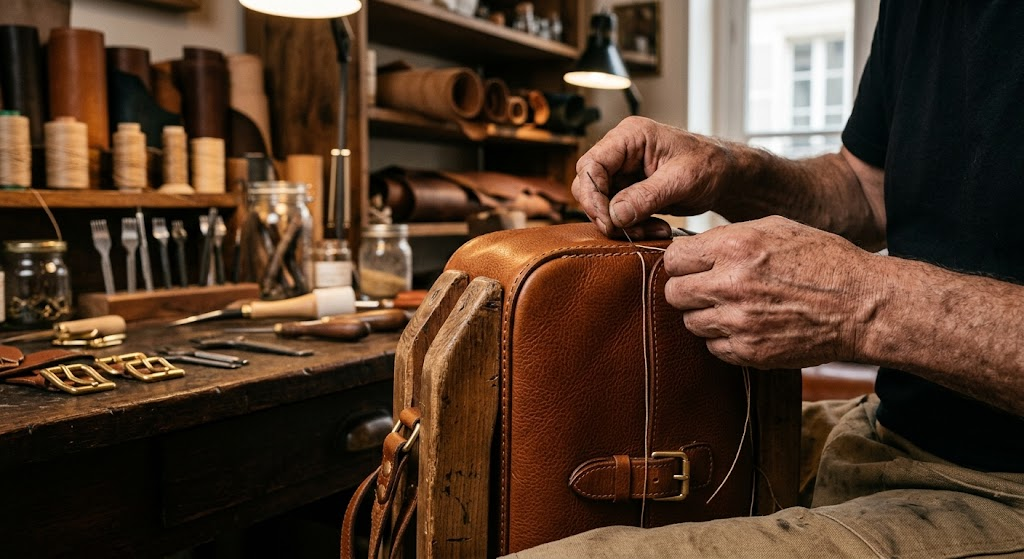
- The Stitching Clam (Pince à Coudre): A tall, elegant wooden clamp crafted from steamed beechwood or ash, held firmly between the artisan’s knees. It suspends the leather workpieces securely at chest height, freeing both of the craftsman’s hands to manipulate the twin needles and the awl in an uninterrupted, rhythmic dance.
The Structural Architecture: Internal Engineering of Luxury Leather Goods
To the untrained eye, a luxury handbag or portfolio appears to be a simple construction of an exterior leather shell joined to an interior lining. In reality, the exterior leather represents merely the visible facade of a complex, multi-layered architectural system.
If you were to take a cross-section of a structured luxury bag, you would discover a carefully balanced sandwich of specialized internal reinforcements, each chosen for its weight, directional flexibility, recovery memory, and moisture resistance.
CROSS-SECTION OF A LUXURY ACCESSORY PANEL:
-------------------------------------------------------------------------
[1] EXTERIOR LEATHER         (Full-grain calfskin, skived at margins)
-------------------------------------------------------------------------
[2] INTERFACING MEMORY LAYER (Salpa / Bonded Leather Fiber / Microfiber)
-------------------------------------------------------------------------
[3] STRUCTURAL CORE          (Vegetable-tanned shoulder, texon board, or brass)
-------------------------------------------------------------------------
[4] CUSHIONING / VOLUME FOAM (Natural wool felt or high-density micro-cell)
-------------------------------------------------------------------------
[5] LINING BACKER TAPE       (Reinforced anti-stretch grosgrain tape at seams)
-------------------------------------------------------------------------
[6] INTERIOR LINING          (Full-grain Chevre / French kidskin)
-------------------------------------------------------------------------
The Hidden Reinforcement Hierarchy
- Salpa (Bonded Leather Board / Synderme): Produced by pulverizing vegetable-tanned leather scraps and re-bonding them with natural latex binders, Salpa provides a firm yet flexible foundation. Unlike cardboard, Salpa breathes, bends without creasing sharply, and accepts water-based glues seamlessly. It gives structured bags their dignified posture without adding unnecessary dead weight.
- Natural Cork and Wool Felt: Used extensively in luxury handles, gusset transitions, and the body panels of heritage trunks. Wool felt imparts a luxurious, soft bounce beneath the leather without the chemical degradation associated with cheap petroleum-based synthetic foams, which inevitably crumble into powder after five to ten years.
- Microfiber and Non-Woven Structural Films: In ultra-modern luxury accessories where extreme lightness is required alongside tear resistance (such as ultra-slim bifolds or travel totes), master ateliers utilize high-tensile technical woven matrices. These materials prevent the outer leather from stretching around hardware stress points and handle anchors.
- Wooden and Metal Reinforcements: In the structural spines of heritage briefcases, doctor bags, and bespoke luggage, artisans embed featherweight tempered spring-steel stays or kiln-dried poplar wood strips. These hidden armatures distribute the downward pull of heavy contents across the entire width of the frame, ensuring the top panel never sags or puckers.
The Art of Skiving and Splitting
A luxury accessory can never look bulky, clumsy, or unfinished at the seams. To achieve razor-sharp folded edges and clean seams, the edges of every single leather component must undergo skiving (parage).
Using high-precision mechanical bell-skiving machines followed by meticulous hand-blade tuning, the artisan tapers the perimeter of a 1.8mm-thick panel down to a paper-thin 0.4mm. When two skived panels are joined, folded, and stitched together, the resulting joint remains completely flush and flexible, eliminating heavy, unsightly ridges.
The Pinnacle of Joinery: The Saddle Stitch vs. The Machine Lockstitch
There is no single technical detail that separates bespoke haute maroquinerie from industrial luxury more decisively than the method of stitching. The marketing departments of commercial brands frequently boast of “handcrafted” construction, yet virtually all commercial leather goods are assembled using electric sewing machines.
Understanding the fundamental mechanical difference between a Machine Lockstitch and a traditional Hand Saddle Stitch (Point Sellier) reveals why true hand-stitching remains completely irreplaceable.
THE MACHINE LOCKSTITCH (Vulnerable to unraveling)
Upper Thread:   ========O===========O===========O===========O========
                       /             \         /             \
                      /               \       /               \
Lower Thread:   ~~~~~~O~~~~~~~~~~~~~~~O~~~~~~~O~~~~~~~~~~~~~~~O~~~~~~
(If the upper thread breaks at any point, both threads instantly unravel)

-------------------------------------------------------------------------

THE ARTISANAL SADDLE STITCH (Interlocked, self-locking)
Needle A Thread:  -----\     /-----\     /-----\     /-----\     /----
                        \   /       \   /       \   /       \   /
                         \ /         \ /         \ /         \ /
Needle B Thread:  -------/ \---------/ \---------/ \---------/ \------
(Two independent needles cross through the same hole. If one thread breaks,
 the opposing stitch remains locked and tensioned by the friction fit)
The Mechanics of the Saddle Stitch
The saddle stitch is an ancient technique developed by harness makers whose lives depended on the absolute reliability of their tack:
- A Single Length of Waxed Linen Thread: The artisan cuts a single piece of heavy-duty French linen thread (such as Fil Au Chinois), conditions it with natural beeswax to lubricate its passage and protect against moisture, and threads an unsharpened harness needle onto both ends of the string.
- Two Needles, One Hole: The artisan uses a diamond awl held in the right hand to pierce the leather held in the stitching clamp.
- The Double Pass and Cast: The right-hand needle passes through the fresh hole; the left-hand needle then enters the exact same hole from the opposite side, crossing over or under the first thread to form an internal mechanical knot (the cast).
- Simultaneous Manual Tensioning: The artisan pulls both ends outward with uniform, rhythmic tension, locking the knot deep into the center of the leather sandwich.
Why the Lockstitch Fails Over Time
An automated sewing machine uses two separate threads: an upper spool and a lower bobbin. The machine punches a single needle down through the leather, loops the top thread around the bottom thread, and pulls the loop back up into the hole.
- The Structural Weakness: The threads do not pass fully through from one side to the other; they merely interlock midway. If a machine-sewn thread experiences abrasion and snaps at any point, the entire line of stitching rapidly unzips under minimal tension.
- The Aesthetic Disparity: A machine lockstitch creates straight, parallel dashes on the front and back. A hand-executed saddle stitch creates a gorgeous, slanted herringbone angle on both faces of the leather, with every single stitch sitting securely at an identical 45-degree angle.
- Repairability: A hand-saddle-stitched bag can be repaired seamlessly stitch-by-stitch by an artisan fifty years after its creation. A machine-sewn seam often requires total destruction of the seam line to re-stitch.
Edge Finishing: The Decisive Mark of the Master Craftsman
When inspecting a luxury leather accessory, do not look first at the brand logo. Look directly at the edges. Raw cut leather edges are fibrous, porous, and highly vulnerable to water penetration, dirt accumulation, and premature splitting. How an atelier resolves these raw boundaries separates the sublime from the mediocre.
Artisans rely on three primary methods of edge treatment, each demanding varying levels of skill, time, and structural engineering.
+-------------------+-----------------------------------+------------------------------------+
| EDGE TECHNIQUE    | PROCESS & EXECUTION               | CHARACTERISTICS & DURABILITY       |
+-------------------+-----------------------------------+------------------------------------+
| Edge Painting     | Multiple layers (4–7) of pigment  | Clean, modern, smooth silhouette.  |
| (Tranche Finie)   | applied, sanded, heated & ironed  | Can crack over time if low quality |
+-------------------+-----------------------------------+------------------------------------+
| Burnishing        | Friction-rubbed with natural gums | Ultra-durable, natural, organic.   |
| (Edge Slicking)   | (Tragacanth) & beeswax via wood   | Exclusively for vegetable leather  |
+-------------------+-----------------------------------+------------------------------------+
| French Binding    | Skived leather strip wrapped and  | Elegant, heirloom finish. Highly   |
| (Rembordé)        | stitched around the raw core edge | complex; exceptional longevity     |
+-------------------+-----------------------------------+------------------------------------+
The Rigorous Art of Multi-Layer Edge Painting (Filetage et Teinture)
Edge painting is the standard of elegance for chrome-tanned and luxury calfskin accessories. However, there is a monumental difference between a single coat of thick, rubbery plastic edge paint applied in mass production and the artisanal edge painting executed in top Parisian ateliers:
- Base Sanding and Leveling: The assembled edge is hand-sanded with progressive grits (from 320 up to 1000) until the separate layers of leather, reinforcement, and lining become a single, indistinguishable plane.
- Edge Creasing (Filetage): The artisan uses a specialized electric or alcohol-heated brass creaser (filet) to run along the edge. The calibrated heat melts the structural collagen fibers, compacting the boundary and pressing a decorative, crisp guideline parallel to the seam.
- Application of the Primer (Mastic): A base sealant is applied to fill the microscopic valleys between the leather fibers.
- The Iterative Cycle of Paint, Dry, Sand, and Iron: The colored edge paint is applied manually with an edge-roller pen or wooden spatula. Once dry, it is sanded down completely flat. It is then smoothed with a hot iron to polymerize the paint deep into the leather pores. This demanding cycle is repeated four to seven times until the edge forms a perfectly rounded, satin-smooth dome that feels like polished glass.
The Traditional Burnished Edge
Burnishing is reserved exclusively for vegetable-tanned leathers. Because vegetable-tanned fibers contain natural tannins and waxes, they can be thermally fused using friction alone.
The craftsman applies a natural water-based gum (such as gum tragacanth or Tokonole) and rigorously rubs the edge using a grooved wooden slicker fashioned from dense hardwood like ebony or cocobolo. The friction generates localized heat, melting the natural fibers and waxes together. Once smooth, the edge is sealed with pure beeswax and buffed vigorously with a canvas cloth, yielding an indestructible, glassy seal that will never peel or crack.
Hardware Metallurgy: The Jewels of Leather Craft
Hardware on a luxury accessory is far more than a functional closure—it is structural architecture and jewelry combined. High-end ateliers design their metal components with the same metallurgical rigor applied to haute horlogerie.
       [ CROSS-SECTION: LUXURY HARDWARE FINISH ]
       +-----------------------------------------------+
       | PALLADIUM / 24K GOLD ELECTROPLATING (3-5 µm)  |  <-- Mirror luster, tarnish resistance
       +-----------------------------------------------+
       | HARDENED BARRIER LAYER (Palladium/Nickel-Free)|  <-- Corrosion stop
       +-----------------------------------------------+
       | HIGH-PURITY SOLID FORGED BRASS BASE           |  <-- Substantial weight, structural integrity
       +-----------------------------------------------+
Solid Forged Brass vs. Zamak Die-Casting
To understand hardware quality, one must understand base metallurgy:
- Zamak / Zinc Alloy Die-Casting: Mass-market and entry-luxury brands rely heavily on Zamak—a low-melting-point alloy of zinc, aluminum, magnesium, and copper. Zamak is injected into molds rapidly and cheaply. While lightweight and easy to cast into intricate shapes, it is brittle, prone to internal porosity, and feels noticeably light and tinny in the hand. If scratched, the grey, chalky zinc core oxidizes quickly.
- Solid Forged Brass (Laiton Massif): True luxury accessories utilize solid brass that is either hot-forged, precision-milled via multi-axis CNC machines, or hand-chased. Brass offers substantial physical heft, supreme tensile strength, and cold-to-the-touch thermal mass. Even if decades of heavy friction wear through the outer plating, the underlying metal emerges as warm, golden brass that patinas gracefully alongside the leather.
Plating Standards: Micron-Level Excellence
Luxury metal components do not receive a brief, micro-thin “flash” dip of coloring. They undergo industrial-grade multi-bath galvanic electroplating:
- Precious Metal Baths: Hardware is submerged in sequential electrolytic baths to deposit substantial layers of genuine 24-karat gold, 18-karat rose gold, palladium, or ruthenium.
- Micron Thickness: While mass-market hardware features plating thicknesses of less than 0.1 microns (which wears off within months, exposing bare metal), luxury-grade hardware is plated to a thickness of 3 to 5 microns, often backed by a titanium or physical vapor deposition (PVD) barrier to ensure scratch resistance and lifetime tarnish prevention.
- Hand Polishing (Guillochage and Chamfering): Prior to plating, every individual buckle, D-ring, swivel clasp, and turnlock is hand-polished using cotton wheels and jewelers’ rouge to eliminate casting lines, create crisp chamfered facets, and ensure mirror-like reflections on flat surfaces.
Connoisseur’s Buying Guide: Evaluating an Investment-Grade Accessory
When stepping into a luxury boutique or assessing a potential purchase on the secondary market, you must bypass the lighting, the interior decor, and the salesperson’s script. Apply this comprehensive inspection protocol to evaluate the authentic craftsmanship of the piece:
+--------------------------------------------------------------------------+
|                  THE 7-POINT ATELIER INSPECTION CHECKLIST                |
+--------------------------------------------------------------------------+
| [ ] 1. SCENT AUDIT: Rich, woody, earthy notes (NO harsh chemical odors) |
| [ ] 2. GRAIN CONTINUITY: Consistent density, no artificial peeling films|
| [ ] 3. SEAM ALIGNMENT: 45-degree angled stitches; tight, uniform tension |
| [ ] 4. EDGE DOME: Perfectly smooth, continuous satin edge; no bubbling   |
| [ ] 5. WEIGHT BALANCE: Solid brass anchor points; center-balanced handle |
| [ ] 6. GUSSET HARMONY: Symmetrical folding; no uneven creasing or bulk   |
| [ ] 7. LINING INTEGRITY: Full-grain leather interior (no synthetic base) |
+--------------------------------------------------------------------------+
The Practical Inspection Protocol
- Perform the Olfactory Test: Place the leather within a few inches of your nose. High-grade full-grain leather smells earthy, rich, sweet, and faintly woody from tannins and natural nourishing oils. If you detect a sharp, volatile solvent smell, chemical paint aroma, or petroleum odor, the accessory has been treated with heavy synthetic coatings to mask inferior split hides.
- Conduct the Thumb Grain Tension Test: Press your thumb firmly into a flat panel of the bag and push gently along the surface.
- Natural Full Grain: The leather will display tiny, organic micro-wrinkles that radiate outward from your thumb, disappearing instantly when pressure is released.
- Corrected/Plastic-Coated Grain: The surface will depress like a sheet of stiff rubber, retaining a broad, smooth indentation without micro-wrinkles, indicating a heavy polyurethane barrier.
- Inspect the Stitching Terminations (Points d’Arrêt): Examine where a line of stitching ends—especially around handle bases and pockets.
- Artisanal Standard: The artisan back-stitches precisely two to three holes into the original diamond piercings, locking the thread invisibly before trimming and hand-tucking the linen fibers inside the seam.
- Industrial Production: The thread ends are melted off with a quick blast of a synthetic heat-gun, leaving an ugly, hard black plastic globule on the surface.
- Audit the Interior Linings: Luxury does not stop at the exterior facade. Open the bag and feel the interior walls and pocket linings. True luxury goods are fully lined with glove-soft French kidskin (chèvre), supple nappa calf, or dense natural suede. If a luxury-priced bag features inexpensive woven nylon, polyester blends, or synthetic vinyl inside its primary compartments, structural cost-cutting has occurred.
- Examine the Zipper Mechanics: A premier leather house utilizes precision-engineered zippers—such as Swiss Riri, Italian Lampo, or custom-milled house components. Every individual tooth should be individually beveled, chamfered, and hand-polished. When drawn, the zipper slider should glide with a smooth, continuous, buttery resistance rather than a harsh, scratchy mechanical rattle.
Preservation and Longevity: The Science of Leather Care
An exceptional leather accessory is fundamentally dynamic: it absorbs ambient humidity, responds to the heat of the body, and loses natural moisture through evaporation. Maintaining an heirloom-grade piece requires a structured care routine grounded in material chemistry.
+------------------+----------------------------------+------------------------------------+
| HAZARD           | THE UNDERLYING DAMAGE            | PREVENTATIVE PROTOCOL               |
+------------------+----------------------------------+------------------------------------+
| Dehydration      | Collagen fibers stiffen & snap   | Bi-annual conditioning with creams |
| Excessive Water  | Tannins wash out; spotting/rot   | Gentle blotting; air dry at room T |
| Direct Sunlight  | UV rays break dye & oxidize fats | Store in breathable cotton dustbag |
| Stagnant Storage | Moisture trap triggers mold      | Never store in plastic containers  |
+------------------+----------------------------------+------------------------------------+
The Golden Rules of Leather Maintenance
- Conditioning Without Suffocation: Avoid heavy petroleum jelly, mineral oil, or low-grade silicone sprays. Silicone forms an impermeable synthetic seal over the pores, preventing the leather from breathing and permanently blocking future nourishment. Instead, use delicate, all-natural conditioning creams formulated with beeswax, neatsfoot oil, macadamia seed oil, or lanolin (such as Saphir Médaille d’Or Renovateur).
- The Wipe-Down Ritual: After returning from daily use, gently wipe the exterior of the accessory with a dry, lint-free microfiber cloth. This removes microscopic airborne particulates, salt crystals from human perspiration, and road dust before they can settle into the grain pores and act as fine abrasives.
- Handling Liquid Emergencies: If your vegetable-tanned accessory encounters heavy rain, never use an artificial heat source like a hair dryer, radiator, or direct sunlight to dry it. Rapid forced heating shrinks the collagen fibers permanently, causing the leather to warp and crack like dried mud. Instead, gently blot the surface moisture with a clean, unbleached microfiber towel, stuff the interior with acid-free tissue paper to maintain its architectural form, and allow it to dry slowly at stable room temperature.
- Storage Architecture: When resting your accessories in a wardrobe, always store them inside their original breathable 100% cotton dust bags. Never store fine leather in sealed plastic bins or vinyl garment bags; the trapped moisture cannot escape, creating an ideal breeding environment for destructive mold and mildew spores.
The Future of the Craft: Balancing Heritage with Modern Innovation
As we navigate an era increasingly focused on material traceability, climate impact, and technological advancement, the luxury leather sector finds itself at an intriguing crossroads. Discerning collectors are no longer satisfied solely with a prestigious logo; they demand rigorous transparency regarding livestock welfare, tannery water treatment, and long-term sustainability.
                           [ THE MODERN LUXURY LEATHER PARADOX ]
                                             |
                   +-------------------------+-------------------------+
                   |                                                   |
        [ HERITAGE TIMELESSNESS ]                               [ MODERN INNOVATION ]
        * Pure Vegetable Tanning                                * Closed-Loop Water Recycling
        * Manual Saddle Stitching                               * RFID & Digital ID Passports
        * Heirloom Repairability                                * Metal-Free Tanning Chemistry
        * Biodegradable End-of-Life                             * Laser-Precision Yield Mapping
Sustainable Tanning Innovations
The world’s leading tanneries are investing heavily in closed-loop water treatment systems that clean and recirculate up to 98% of process water. Furthermore, innovative metal-free and chrome-free tanning formulations—such as tanning agents synthesized from upcycled olive tree leaves (Wet-Green) or natural zeolite minerals—are gaining ground among high-end designers. These methods provide the vibrant color potential and lightness of mineral tanning without the associated environmental burdens.
Digital Passports and Micro-Chip Traceability
Modern luxury leather accessories are increasingly integrating discreet near-field communication (NFC) chips and digital product passports beneath their linings. These systems allow owners to scan their piece with a smartphone to view the complete immutable provenance: the specific farm where the hide was raised, the tannery that processed it, the date of its workshop assembly, and an authenticated digital certificate of ownership. This marriage of digital transparency with old-world physical craft guarantees authenticity while cementing secondary market value.
The Enduring Value of True Craftsmanship
In a world increasingly shaped by rapid obsolescence, ephemeral digital trends, and disposable synthetics, the creation of a fine leather accessory remains a triumphant statement of patience, material mastery, and human skill.
From the pristine alpine pastures that nurture unblemished hides to the fragrant Tuscan tanning pits, from the rhythmic, muscle-memory cadence of the master saddle-stitcher to the meticulous five-layer edge painting that seals every boundary, authentic leathercraft is an art form that refuses to be hurried.
When you invest in a genuinely handcrafted leather accessory, you are not buying a mere fashion item. You are acquiring a piece of living engineering—an enduring companion designed to accompany you through the chapters of your life, weathering every journey, recording every milestone upon its developing patina, and standing as an eloquent testament to the timeless beauty of the hide.
For those who curate their personal style with discerning intentionality, understanding these deep nuances transforms how you build your collection. At Royal Fashion Tech, we celebrate this union of time-honored artisanal mastery and forward-thinking luxury culture—empowering you to make wardrobe investments that transcend fleeting seasonal cycles and appreciate in personal value for decades to come.
Frequently Asked Questions
What is the difference between full-grain leather and genuine leather?
Full-grain leather is the highest quality leather available. It utilizes the entire, untouched outer layer of the hide where the collagen fibers are at their densest, retaining natural strength, breathability, and the ability to develop a rich patina over time. “Genuine leather,” by contrast, is a broad commercial term typically applied to split leather—the weaker, lower fibrous layers of the hide that have been sanded down, bonded, and coated with synthetic finishes to mimic top-grade leather.
Why is hand saddle-stitching considered superior to machine stitching?
A machine lockstitch uses two separate threads that merely loop together midway through the leather; if one loop breaks, the entire seam unzips under tension. A hand saddle stitch uses two needles on a single length of waxed linen thread, passing fully through the same hole from opposing directions and forming an internal knot. If a saddle-stitched thread breaks, the opposing thread remains locked in place by friction, preventing the seam from unraveling.
How can I tell if a luxury leather item uses real solid brass hardware?
Solid brass hardware feels noticeably heavy, cold to the touch, and non-magnetic. You can test it by placing a small refrigerator magnet against the metal; high-purity brass will show no magnetic attraction. Additionally, under magnification, solid forged brass features crisp, polished chamfers and lacks the rough parting lines or lightweight hollow feel common to cast zinc alloys (Zamak).
What makes vegetable-tanned leather develop a patina while chrome-tanned leather does not?
Vegetable tanning relies on organic tree barks, wood extracts, and plant tannins, leaving the leather’s pore structure open and responsive. As it is exposed to ambient sunlight, atmospheric oxygen, and the natural oils from human hands, these organic compounds oxidize and darken, creating a glossy, rich caramel patina. Chrome tanning uses chromium salts and protective pigment coatings that seal the fibers, locking the color in a relatively static state over its lifespan.
Is expensive leather completely waterproof?
No fine, untreated full-grain leather is entirely waterproof. While high-grade leather can withstand light rain without structural damage, prolonged water exposure can leach out natural tanning oils and leave mineral water rings. Always blot liquid immediately with a soft, clean cloth and allow the leather to air-dry naturally away from artificial heat sources.
How often should a high-end leather bag or briefcase be conditioned?
For items used regularly, a thorough conditioning treatment every six to twelve months is ideal. If you live in an arid climate or frequently use air-conditioned spaces, conditioning every three to four months may be required. Always use a gentle, natural cream containing beeswax, lanolin, or neatsfoot oil, and test a small, inconspicuous area before treating the entire piece.
Why do some luxury calfskin bags scratch so easily, and how can they be fixed?
Ultra-luxurious, minimally finished leathers—such as Barenia or untreated aniline calfskins—feature open, natural surfaces with no artificial plastic coatings, making them susceptible to light surface scratches. However, because these leathers are richly nourished with natural oils, most minor superficial fingernail marks can be buffed out simply by rubbing the area gently in circular motions with the warmth of a clean thumb or a soft horsehair brush.
Can cracked edge paint on a luxury handbag be repaired?
Yes. Professional luxury leather restoration ateliers can repair cracked edge paint. The craftsman carefully strips away the damaged old sealant, cleans and levels the raw leather seam, and applies several fresh layers of color-matched edge paint, ironing and sanding between each coat to restore the original factory finish.