For decades, the definition of luxury was anchored in excess, rarity, and unblemished perfection. A pristine bolt of virgin silk, an untouched hide of calfskin, or a tailored jacket fresh from an exclusive European mill represented the pinnacle of high fashion. The modern fashion landscape, however, is undergoing a profound conceptual transformation. Connoisseurs, collectors, and legacy fashion houses are shifting their gaze toward a new aesthetic dimension: the art of high-end transformation. Waste, once the quiet byproduct of an industry obsessed with speed and seasonality, has been elevated to the absolute vanguard of haute couture and artisanal tailoring.
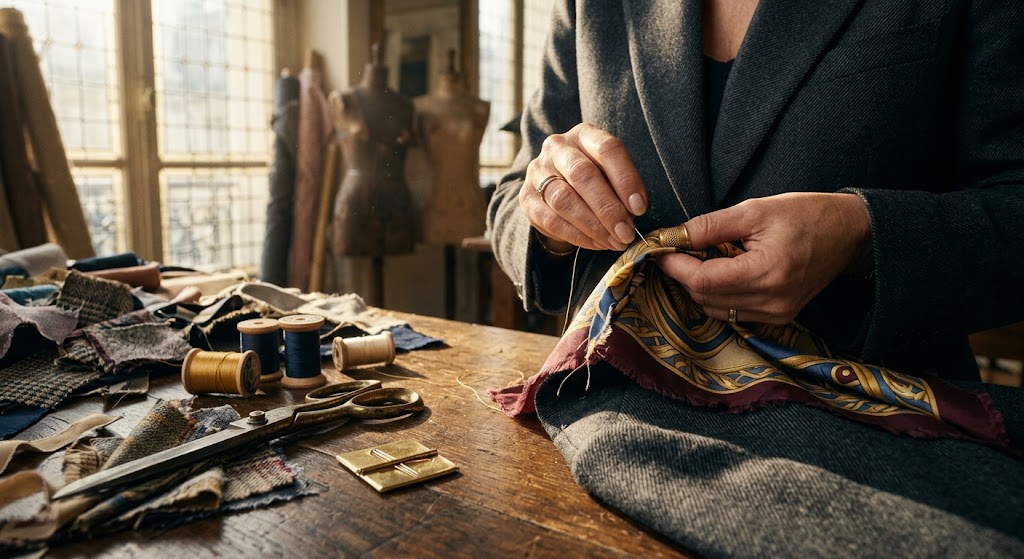
This movement is far deeper than a seasonal trend or an exercise in corporate public relations. Luxury upcycled fashion redefines how we evaluate value, prestige, and craftsmanship. By rescuing archival textiles, industrial deadstock, vintage heirlooms, and production offcuts, avant-garde designers and heritage houses are breathing vitality into materials that were destined for incineration or landfills. In doing so, they are producing garments endowed with something traditional mass-luxury often lacks: a distinct narrative, historical depth, and true individuality.
In this deep editorial exploration, we examine the mechanics, aesthetics, and cultural momentum behind luxury upcycled fashion. You will discover the technical distinctions between industrial recycling and artisanal upcycling, understand why deadstock and salvaged textiles command premium prices, explore actionable frameworks for identifying master-tier craftsmanship, and learn how to curate, style, and care for upcycled statement pieces within a modern luxury wardrobe.
The Paradigm Shift: Redefining Luxury Through the Lens of Circularity
The luxury sphere has reached an inflection point. For generations, the fashion system operated on a linear model: extract raw resources, weave pristine textiles, produce seasonal collections, and discard the surplus to maintain exclusivity and market demand. Unsold garments were frequently incinerated or shredded behind locked atelier doors to preserve brand prestige and artificial scarcity.
Today, this paradigm is collapsing under its own weight. Discerning clients are no longer swayed solely by pristine newness; they increasingly view unreflective production as antiquated and uninspired. True luxury in the modern era has shifted from mass exclusivity to authentic distinction, artisanal preservation, and conscious provenance.
Linear Luxury Model:
[ Raw Resource Extraction ] ➔ [ Virgin Milling ] ➔ [ Seasonal Assembly ] ➔ [ Discard / Incinerate Surplus ]

Circular Luxury Model:
[ Archival / Deadstock Sourcing ] ➔ [ Deconstruction & Restoration ] ➔ [ Bespoke Artisanal Upcycling ] ➔ [ Enduring Wardrobe Integration ]
When a designer takes a vintage silk jacquard from a shuttered Lyon mill, a pair of worn selvedge denim trousers from the mid-twentieth century, or discarded leather remnants from an artisanal upholstery workshop, the resulting garment carries a rich, tactile history. It ceases to be an anonymous commodity produced by the thousands; it becomes a piece of wearable art with an identifiable origin story.
Circularity does not compromise luxury standards; it enhances them. Transforming irregular, limited, or delicate salvaged materials into a flawlessly draped evening gown or a structured bespoke blazer demands significantly higher technical prowess than cutting patterns from uniform rolls of virgin fabric. Tailors and pattern cutters must work intuitively, adapting their structural blueprints to the unique grain, grainline quirks, and architectural boundaries of each reclaimed piece.
In this light, luxury upcycling is not a compromise or a secondary alternative. It represents the pinnacle of modern tailoring—a discipline where master craftsmanship meets environmental stewardship, resulting in garments that are rare, technically complex, and inherently individual.
The Alchemy of Remaking: Distinguishing Upcycling from Traditional Recycling
To appreciate why luxury upcycled fashion commands haute couture pricing, one must understand the stark operational and philosophical differences between downcycling, mechanical recycling, and artisanal upcycling.
| Metric | Industrial Mechanical Recycling | Artisanal Luxury Upcycling |
| Material Input | Post-consumer blended waste, polyester fibers, low-grade cotton scraps. | Archival luxury silks, mill overstock, vintage wools, salvaged leather hides. |
| Processing Method | High-energy mechanical shredding, chemical melting, re-extrusion. | Hand deconstruction, steam relaxation, bespoke pattern drafting, master tailoring. |
| Structural Integrity | Shortened fiber length, lower tensile strength, often requires virgin blends. | Preserved original fiber length, high-grade vintage density, enhanced structural life. |
| Aesthetic Output | Homogeneous, uniform base textiles for utilitarian garments. | One-of-a-kind statement pieces with rich patina, historical depth, and textural variety. |
| Labor Profile | High automation, low customization, rapid industrial turnover. | High artisanal labor hours, tailored pattern cutting, hand-finishing techniques. |
| Final Market Value | Fast-fashion staples, low-tier basics, utility gear. | Haute couture, demi-couture, investment luxury collector pieces. |
Traditional mechanical recycling is often a process of degradation, or downcycling. Post-consumer cotton or polyester garments are collected, stripped of hardware, and fed through industrial shredders that tear the textiles down into raw fibers. This mechanical tearing breaks the staple length of natural fibers like cotton and wool. A long-staple Egyptian cotton fiber, prized for its silky hand-feel and tensile durability, becomes a short, fuzzy, brittle remnant. To spin these shredded remnants back into functional yarn, manufacturers must blend them with virgin synthetic binders or fresh petroleum-based polymers. The resulting fabric is frequently weaker, rougher, and visually uninspiring.
Artisanal luxury upcycling operates in the exact opposite direction. It does not destroy the textile’s cellular or structural integrity. Instead, it honors the original material’s physical qualities while elevating its aesthetic and functional form.
When a master atelier deconstructs a vintage double-faced cashmere coat, the fabric is unstitched along its original seams, relaxed with gentle steam, inspected for fiber health, and re-patterned into a contemporary architectural silhouette. The long, lustrous cashmere fibers remain intact, retaining their natural insulating properties, drape, and cloud-like softness. The process adds value, complexity, and artistic merit to an existing material without industrial degradation or chemical intervention.
This is the alchemy of luxury remaking: elevating surplus, vintage, or discarded components into a finished product whose aesthetic and monetary value exceeds that of the original parts.
Archival Fabrics, Deadstock Silks, and Deconstructed Heritage: The Materials of Choice
The world of luxury upcycled fashion is defined by the extraordinary provenance of its raw materials. While industrial fashion relies on bulk synthetic production, upcycling ateliers act as textile archivists, sourcing exceptional remnants from forgotten corners of the luxury supply chain.
                  ┌─────────────────────────────────┐
                  │    LUXURY UPCYCLING SOURCES     │
                  └────────────────┬────────────────┘
                                   │
         ┌─────────────────────────┼─────────────────────────┐
         │                         │                         │
         ▼                         ▼                         ▼
┌───────────────────┐    ┌───────────────────┐    ┌───────────────────┐
│ ARCHIVAL DEADSTOCK│    │ VINTAGE HEIRLOOMS │    │ INDUSTRIAL SURPLUS│
│ • Mill overruns   │    │ • Silk foulards   │    │ • Aviation hides  │
│ • Cancelled orders│    │ • Boro textiles   │    │ • Parachute nylons│
│ • Haute couture   │    │ • Heritage tweeds │    │ • Sailcloth canvas│
│   surplus rolls   │    │ • Antique tapestries│  │ • Automotive suede│
└───────────────────┘    └───────────────────┘    └───────────────────┘
Mill Overruns and Cancelled Haute Couture Yardage
Every season, premier weaving mills in Biella (Italy), Como (Italy), Lyon (France), and Yorkshire (England) produce limited runs of extraordinary textiles for major couture houses. When a fashion house overestimates its yardage requirements or cancels a production run, dozens or hundreds of meters of pristine silk organza, heavy duchess satin, barathea wool, or hand-loomed tweed are left stranded in climate-controlled warehouses.
These deadstock textiles represent the pinnacle of mill artistry. They feature natural dyes, high thread counts, and structural complexities that are rarely replicated today due to rising production costs. Luxury upcyclers acquire these deadstock bolts, turning forgotten surplus into limited-edition collections that cannot be duplicated once the yardage is exhausted.
Repurposed Silk Carrés and Foulards
Vintage silk twill scarves from heritage European houses are celebrated for their hand-rolled edges, screen-printed illustrations, and rich color saturation. However, thousands of these scarves end up tucked away in vanity drawers or secondary markets with minor local flaws—a single water spot, a minor edge fray, or a small pull.
Upcycling ateliers collect these historic silk foulards, carefully mapping their illustrations to construct:
- Fluid resort shirts with balanced front panels.
- Patchwork kimono jackets lined with washed silk.
- Silk-backed bespoke waistcoats.
- Structural evening corsetry where historical motifs accentuate natural curves.
Heritage Workwear, Denim, and Utilitarian Canvas
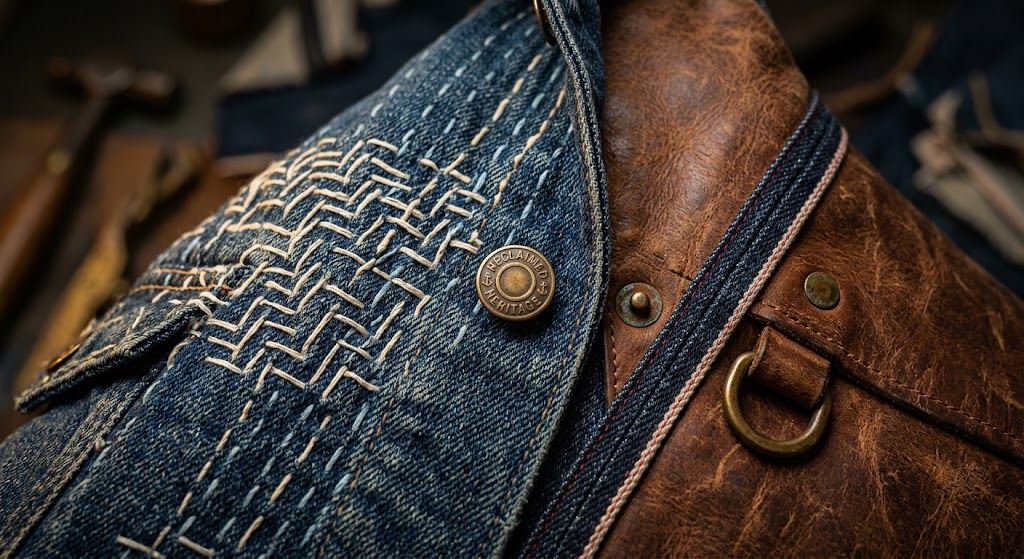
Textiles engineered for industrial, military, or agricultural utility possess an inherent resilience that only improves with time. Authentic vintage Japanese boro fabrics (cotton garments patched and repaired over generations) and mid-century American selvedge denim carry natural fading, distressing, and whiskering that industrial enzyme washes cannot replicate.
When re-cut into structured blazers, tailored overcoats, or architectural tote bags, these textiles bring authentic grit, structural density, and textural balance to a sophisticated wardrobe.
Decommissioned Aviation, Automotive, and Upholstery Leathers
The upholstery industry applies exceptionally rigorous quality controls to its materials. Tanned hides intended for luxury automotive seating, executive aviation interiors, and bespoke furniture must exhibit uniform grain and extreme durability. Offcuts from these industries are thick, supple, and vegetable-tanned to perfection.
High-end upcycling leatherworkers rescue these substantial offcuts, pairing them with archival brass hardware to engineer luxury travel bags, structured moto jackets, and minimalist footwear that outperform conventional consumer-grade leather goods in both aesthetic beauty and structural longevity.
Haute Couture Meets Zero-Waste: The Design Philosophies Leading the Charge
The execution of luxury upcycled fashion requires an entirely different creative approach than conventional ready-to-wear production. In traditional design, a creative director sketches a silhouette, and the manufacturing team orders the exact yardage of uniform fabric required to produce thousands of identical units. The fabric serves the design.
In luxury upcycling, this hierarchy is reversed: the material dictates the design.
CONVENTIONAL LUXURY DESIGN:
[ Creative Sketch ] ➔ [ Order Uniform Fabric ] ➔ [ Standard Pattern Cutting ] ➔ [ Mass Assembly ]

UPCYCLED LUXURY DESIGN:
[ Material Discovery & Analysis ] ➔ [ Structural Mapping ] ➔ [ Adaptive Pattern Drafting ] ➔ [ Artisanal Assembly ]
Material-Driven Geometry and Modular Pattern Making
When an atelier works with vintage textiles or deadstock remnants, they are constrained by the physical parameters of the salvaged material. A bolt of 1970s deadstock silk might only measure forty-five centimeters in width, or a collection of leather scraps might consist of irregular trapezoids and triangles.
Designers must apply advanced geometric problem-solving to draft modular patterns that maximize every square centimeter. This discipline, known as zero-waste or minimal-waste pattern drafting, leads directly to bold design signatures:
- Diagonal panelling and bias-cut construction that enhance drape.
- Complex architectural piecing that flatters the silhouette.
- Contrast topstitching that transforms structural seams into decorative highlights.
- Hidden internal gussets and interior pockets crafted from smaller offcuts.
The Japanese Philosophy of Mottainai and Wabi-Sabi
Much of the aesthetic philosophy underpinning luxury upcycling draws inspiration from Japanese material culture. The concept of Mottainai conveys a deep sense of regret over waste, combined with a reverent appreciation for the resources and labor invested in physical objects.
Complementing this is Wabi-Sabi—the celebration of imperfection, transience, and natural aging. Rather than hiding the signs of wear, repair, or historical patching, luxury upcyclers elevate these elements into focal features.
Techniques such as Sashiko (functional running-stitch reinforcement) and Kintsugi-inspired textile repair (mending tears with contrasting metallic, silk, or indigo threads) transform material histories into elevated design accents.
Traditional Repair (Attempt to Hide):
Textile Tear ───► Color-Matched Blind Stitch ───► Flat, Invisible Repair

Artisanal Upcycled Repair (Wabi-Sabi / Sashiko):
Textile Tear ───► High-Contrast Hand-Stitched Grid ───► Sculptural, Textural Focal Point
Deconstructive Tailoring
Deconstruction in luxury fashion—pioneered by avant-garde European and Japanese masters throughout the late twentieth century—has found its natural home within the upcycling movement. Designers dismantle tailored menswear, vintage military parkas, or corporate wool suits, breaking them down into their foundational elements: shoulder pads, canvas interfacings, sleeve heads, and lapels.
These elements are then reassembled into hybrid silhouettes:
- A vintage double-breasted tuxedo jacket deconstructed into an asymmetric wrap skirt.
- Two mismatched wool overcoats spliced along the spine to create a contrasting two-tone overcoat.
- Military field jackets integrated with delicate lace remnants to balance utilitarian structure with romantic softness.
This design methodology produces garments that feel intellectual, historically grounded, and completely distinct from conventional mass-luxury offerings.
PART 2
Curating an Upcycled Luxury Wardrobe: Connoisseurship and Material Evaluation
Integrating upcycled pieces into a refined personal wardrobe requires a discerning eye. Because upcycled fashion relies on non-standardized materials and artisanal assembly, quality can vary significantly across the market. Discerning collectors evaluate these garments with the same technical scrutiny used for bespoke tailoring or high jewelry.
                ┌───────────────────────────────────┐
                │   UPCYCLED QUALITY CHECKLIST      │
                └─────────────────┬─────────────────┘
                                  │
    ┌─────────────────────────────┼─────────────────────────────┐
    │                             │                             │
    ▼                             ▼                             ▼
[ FIBER DENSITY & TENSILE ]  [ INTERNAL SEAM FINISHING ]  [ HARDWARE INTEGRATION ]
• Rub & pull test            • French or Hong Kong seams  • Solid brass or horn
• Warp & weft alignment      • Bound bias tape edges      • Reinforced stress points
• Natural fiber purity       • Clean internal interior    • Hand-sewn button shanks
The Tactile and Fiber Test
Before purchasing an upcycled investment piece, evaluate the physical integrity of the primary textile. While vintage and deadstock fabrics possess incredible character, they must be structurally sound enough for regular wear.
- The Tensile Resistance Test: Gently apply tension across the warp and weft of the fabric in an inconspicuous area. The textile should feel resilient and snap back into place without fiber slippage or cracking sounds.
- Fiber Composition: Prioritize natural, long-staple fibers—virgin wools, dry silks, heavy linens, and sturdy cotton twills. Be cautious with vintage synthetic blends from the 1960s and 1970s (such as unlined acrylics or early polyesters), which can degrade over time, pill excessively, and trap heat.
- Surface Balance: Examine the grainline. In master-tier upcycling, the designer cuts pattern pieces along the true grain of the salvaged fabric, ensuring the garment hangs straight and will not twist around your body after cleaning.
Inspecting Seam Craftsmanship and Internal Finishing
Because upcycled garments often feature complex patchwork, spliced panels, and mixed-weight materials, internal construction is the ultimate indicator of quality. An upcycled garment should look as clean and refined on the inside as it does on the outside.
POOR CONSTRUCTION (Avoid):
├── Raw, exposed cut fabric edges inside the lining
├── Overlocked/serged polyester thread on delicate silk panels
├── Mismatched tension causing puckering along spliced seams
└── Uneven seam allowances pulling the silhouette off-balance

MASTER-TIER CONSTRUCTION (Look For):
├── Fully bound Hong Kong seams using silk or cotton bias tape
├── French seams enclosing raw edges on sheer and lightweight fabrics
├── Floating internal canvas interfacings supporting heavy patchwork
└── Hand-tacked stress points at pockets, vents, and armscyes
Look for:
- Hong Kong or Bound Seams: High-end ateliers encase raw panel edges in lightweight silk or cotton bias tape. This prevents fraying, reduces bulk against the skin, and creates a clean interior finish.
- French Seams on Lightweight Fabrics: When working with upcycled silk foulards or sheer deadstock voiles, every interior seam should be fully enclosed (a French seam) to prevent thread separation.
- Interfacing and Weight Balancing: Splicing a heavy wool scrap to a lighter cotton panel requires skilled internal reinforcement. The tailor must use floating horsehair canvas or delicate fusible interfacing on the lighter textile to prevent the heavier material from pulling, sagging, or distorting the seam over time.
Hardware, Fasteners, and Detailing
Examine the buttons, zippers, and closures. Master upcyclers do not cut corners with cheap modern plastic hardware. Look for:
- Reclaimed or sustainably sourced horn, mother-of-pearl, corozo nut, or bone buttons.
- Hand-sewn buttonholes with silk thread reinforcement.
- Buttons secured with a structural thread shank to accommodate the fabric’s thickness without pulling the weave.
- Heavy-duty, smooth-running metal zippers (such as RiRi or vintage YKK Excella) seamlessly integrated into reconstructed seams.
The Collector’s Dilemma: Navigating Authenticity, Provenance, and Craftsmanship
As the market value of upcycled fashion surges, collectors face a growing challenge: separating genuine artisanal upcycling from commercial greenwashing. Mass-market retailers have co-opted upcycling language, applying superficial patches or distressing treatments to low-grade factory seconds and marketing them at inflated price points.
                      ┌──────────────────────────────────────┐
                      │    AUTHENTICITY ASSESSMENT MATRIX    │
                      └──────────────────┬───────────────────┘
                                         │
                 ┌───────────────────────┴───────────────────────┐
                 │                                               │
                 ▼                                               ▼
    [ MASS GREENWASHING ]                               [ ARTISANAL UPCYCLING ]
    • Vague origin claims ("recycled mix")              • Specific mill / provenance records
    • Factory-machined identical distressing            • Numbered editions / unique variances
    • High synthetic blend content                      • Fully traceable deadstock sources
    • Mass-produced in thousands of units               • Limited, small-batch atelier runs
Traceability and Provenance Documentation
Authentic luxury upcycling is transparent about material provenance. Reputable designers and ateliers provide clear documentation detailing the origin of their textiles.
When evaluating an investment piece, look for specific provenance details:
- The specific mill, region, or era from which deadstock fabrics were sourced (e.g., “1980s Biella worsted wool overrun” or “1970s deadstock silk twill from Como”).
- The precise history of deconstructed vintage garments (e.g., “Constructed from three pairs of 1960s deadstock military utility trousers”).
- Edition numbering: Because salvaged yardage is finite, authentic upcycled collections are released in strictly limited, individually numbered batches (e.g., Piece 04 of 12).
Be skeptical of vague claims such as “made with recycled textile blends” without clear percentages, material origins, or proof of production methodology.
The Pricing Equation: Understanding True Value
Prospective buyers often ask: If upcycled fashion is made from discarded textiles, surplus, or old garments, why does it cost as much as—or more than—conventional luxury?
The answer lies in the shift from material cost to labor intensity and specialized skill.
Conventional Luxury Cost Distribution:
[ Virgin Material Costs: 35% ] ── [ Automated Production: 15% ] ── [ Marketing/Brand Markup: 50% ]

Artisanal Upcycled Cost Distribution:
[ Material Sourcing/Restoration: 25% ] ── [ Bespoke Artisanal Tailoring: 55% ] ── [ Operations/Markup: 20% ]
- Sourcing and Curation Labor: Finding, verifying, and testing deadstock rolls or archival garments requires significant expertise and time spent working with specialized textile liquidators, collectors, and mill archives.
- Material Restoration: Salvaged fabrics must be carefully inspected, cleaned with eco-conscious agents, hand-ironed, and relaxed before a single cut is made.
- Non-Standardized Cutting: In traditional production, computer-controlled laser tables cut hundreds of stacked fabric layers simultaneously. Upcycled garments must be hand-cut one piece at a time to navigate patterns, grainline variations, or localized fabric flaws.
- Artisanal Handwork: Reconstructing complex deconstructed garments requires skilled pattern cutters and senior tailors, not assembly-line operators.
You are not paying for the scrap value of discarded fabric; you are investing in master-level labor, one-of-a-kind design, and specialized pattern architecture.
High-Fashion Styling Blueprints: Integrating Upcycled Statements into Modern Tailoring
An upcycled piece should never look like an unstudied novelty or a costume. The key to wearing upcycled luxury lies in balancing historical texture with clean, minimalist modern tailoring.
Upcycled Styling Formula:
[ 1 High-Texture Upcycled Focal Piece ] + [ 2-3 Clean, Architectural Minimalist Staples ] = Modern Luxury Aesthetic
Blueprint 1: The Architectural Statement Coat
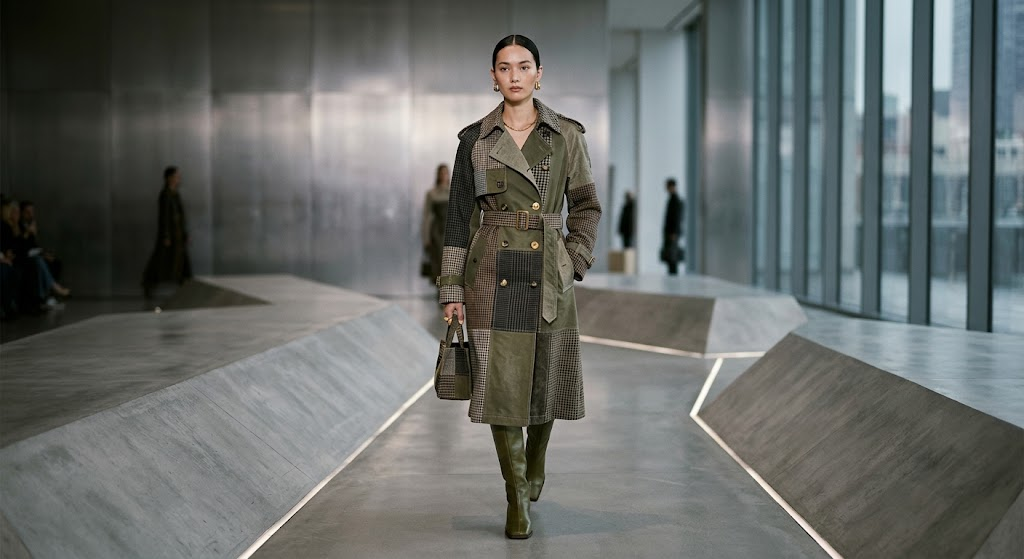
An upcycled coat constructed from contrasting deadstock wools, vintage tweed remnants, or deconstructed trench coats serves as the commanding focal point of any ensemble.
[ Reconstructed Multi-Tweed Overcoat ]
                 │
                 ├── Inner Base: Charcoal Extrafine Merino Wool Turtleneck
                 ├── Trousers: Crisp Wide-Leg Black Wool Trousers (Clean Break)
                 └── Footwear: Polished Calfskin Chelsea Boots (Minimalist Hardware)
- The Anchor: A reconstructed multi-tweed knee-length overcoat.
- The Canvas: Keep the underlayers sleek, dark, and monochromatic. Pair with a fine-gauge charcoal merino wool turtleneck and high-waisted, wide-leg virgin wool trousers.
- The Shoes: Minimalist black box-calf leather Chelsea boots or unembellished leather loafers.
- Styling Note: Let the complex geometry of the coat speak for itself. Avoid patterned shirts, printed scarves, or competing textures around the neckline.
Blueprint 2: The Repurposed Silk Focal Shirt
Silk shirts constructed from vintage foulards or deadstock jacquards feature vibrant prints, historical crests, and bold color palettes.
[ Upcycled Vintage Silk Twill Foulard Shirt ]
                 │
                 ├── Layering: Unstructured Navy Double-Breasted Flannel Suit
                 ├── Waist: Minimalist Matte Leather Belt with Silver Buckle
                 └── Footwear: Burnished Cognac Loafers or Dress Derbies
- The Anchor: A silk twill button-down shirt engineered from repurposed vintage scarves.
- The Tailoring: Wear beneath an unstructured, modern double-breasted suit in deep navy or slate grey. The crisp tailoring frames the vibrant silk, showing a refined flash of print at the lapel, collar, and cuffs.
- The Accessories: Keep jewelry minimal—a vintage mechanical watch with an unstitched leather strap and a clean signet ring.
- Styling Note: Leave the collar open naturally. Avoid wearing a necktie, which creates visual clutter against the shirt’s printed panels.
Blueprint 3: Deconstructed Denim Meets Formal Eveningwear
Upcycled denim blazers or patched selvedge trousers bring depth to formal tailoring.
[ Bespoke Upcycled Selvedge Denim Tailored Jacket ]
                 │
                 ├── Inner Layer: Crisp Poplin Pleated Dress Shirt (Stiff Collar)
                 ├── Neckwear: Midnight Blue Silk Satin Bow Tie
                 └── Lower Body: Midnight Tuxedo Trousers with Silk Side Braiding
- The Anchor: A bespoke jacket tailored from vintage selvedge denim offcuts with contrasting indigo saturation.
- The Contrast: Style with crisp white cotton poplin dress shirting, a black silk-satin cummerbund or waistcoat, and tailored black evening trousers featuring a silk grosgrain side stripe.
- The Footwear: Patent leather dress slippers or velvet smoking shoes.
- Styling Note: The tension between rugged indigo textures and sleek black evening silk creates a memorable contrast suitable for gallery openings, creative galas, and private dinners.
Blueprint 4: The Modular Upcycled Leather Accessory
If you prefer an understated introduction to circular fashion, start with leather goods crafted from upholstery offcuts or aviation hides.
[ Patchwork Aviation-Leather Briefcase or Weekender ]
                 │
                 ├── Outerwear: Unlined Double-Face Camel Hair Overcoat
                 ├── Base: Cashmere Crewneck Sweater & Raw Denim Trousers
                 └── Footwear: Hand-Welted Horween Leather Oxford Shoes
- The Anchor: An architectural tote or briefcase pieced from rich cognac and espresso aviation-grade leather remnants.
- The Outfit: Pair with a minimalist double-face camel coat, a cream cashmere crewneck, and dark raw denim.
- The Result: The bag’s subtle seam geometry and natural grain variations add personality to an otherwise quiet, understated outfit.
Preservation, Longevity, and the Future of Circular Luxury
Owning an upcycled luxury garment carries a responsibility to care for its materials properly. Because an upcycled piece may combine different fabrics—such as a wool blazer panel spliced with a silk lapel and cotton twill pockets—cleaning and maintenance require thoughtful attention.
                 ┌──────────────────────────────────────┐
                 │   UPCYCLED CARE & LIFECYCLE GUIDE    │
                 └──────────────────┬───────────────────┘
                                    │
    ┌───────────────────────────────┼───────────────────────────────┐
    │                               │                               │
    ▼                               ▼                               ▼
[ CLEANING PROTOCOLS ]     [ STORAGE ARCHITECTURE ]        [ REPAIR & RESTORATION ]
• Specialist eco-dry cleaners • Broad contoured wood hangers  • Visible artisanal mending
• Spot treat mixed textiles   • Breathable cotton garment bags• Continuous repair history
• Low-temp, targeted steam    • Cedar blocks for moth defense • Generational preservation
Specialized Cleaning for Mixed-Media Garments
Standard commercial dry cleaning involves harsh chemical solvents (such as perchloroethylene) and high-heat mechanical tumbling, which can degrade vintage fibers or cause mixed fabrics to shrink unevenly.
- Seek Out GreenEarth Cleaners: Use professional dry cleaners that utilize liquid silicone solvents (GreenEarth) or wet-cleaning technologies. These methods clean fibers gently without stripping their natural oils.
- Spot Cleaning and Steaming: Clean vintage silks and delicate wools selectively by spot cleaning minor spills immediately with pH-neutral soap. Use low-temperature, indirect steam to refresh fibers and eliminate odors between wears, avoiding direct iron-to-textile contact.
- Mind Differential Shrinkage: If an unlined garment contains both wool and cotton panels, never submerge it in hot water. Wool fibers will felt and shrink, while the cotton remains stable, causing severe seam puckering and structural warping.
Storage and Structural Support
Preserve the shape of upcycled tailoring through proper storage techniques:
- Contoured Wooden Hangers: Always hang heavy upcycled blazers and reconstructed coats on broad, contoured wooden wishbone hangers. Wire or thin plastic hangers will distort the shoulder pads, stretch spliced yoke seams, and ruin the silhouette.
- Breathable Garment Bags: Store off-season investment garments in unbleached, breathable 100% cotton garment bags. Avoid non-breathable plastic covers, which trap humidity and encourage fiber dry-rot or yellowing on archival textiles.
- Moth Prevention: Protect raw wool, cashmere, and deadstock silk twills with natural cedar blocks and lavender sachets. Replace or sand the cedar blocks annually to maintain their natural repellent oils.
The Long Horizon: Circularity as the Future Baseline of Luxury
As digital product passports (DPPs) and blockchain-verified material traceability become standard across Europe and North America, the provenance of every upcycled luxury garment will soon be traceable back to its original mill run, former life, and artisan workshop via an encrypted scan.
Luxury upcycling is not an experimental design niche; it is the blueprint for the future of the fashion industry. By pairing environmental stewardship with the highest expressions of tailoring and couture, luxury upcycling proves that high style and circular responsibility can elevate one another.
When you purchase, wear, and preserve an upcycled luxury piece, you do more than acquire a beautiful garment. You become the custodian of a living piece of textile history—a personal statement proving that the future of luxury lies in thoughtful reinvention rather than unconsidered consumption.
The Connoisseur’s Roadmap: Key Actions for the Discerning Wardrobe
Building a curated wardrobe that balances modern luxury with circular upcycling requires intentional planning. Use this concise roadmap to guide your acquisition and styling strategy:
[ EVALUATE ] ──► Assess existing wardrobe gaps and prioritize investment categories (e.g., outerwear, statement shirts).
     │
[ INSPECT ]  ──► Scrutinize internal construction: verify bound seams, natural fiber purity, and pattern grainline alignment.
     │
[ AUTHENTICATE ] ► Request provenance details: confirm deadstock origins, mill history, or batch edition numbering.
     │
[ STYLE ]    ──► Anchor the upcycled statement piece with clean, monochromatic, and architectural staples.
     │
[ PRESERVE ] ──► Store on contoured wooden hangers, clean via gentle eco-solvents, and practice visible hand-mending.
By following this approach, your wardrobe will not only reflect sophisticated personal style, but will also champion the finest traditions of artisanal craft, preservation, and circular design.
Conclusion
The emergence of luxury upcycled fashion marks one of the most exciting creative and philosophical evolutions in modern sartorial history. By transforming deadstock yardage, archival silks, and heritage workwear into runway-tier masterpieces, the industry is proving that luxury is defined by artisanal vision, technical skill, and narrative depth rather than unchecked consumption.
To embrace upcycled luxury is to demand more from the clothes we wear. It invites us to celebrate the beauty of hand-finished seams, appreciate the texture of vintage weaves, and cherish garments that carry a genuine history. At Royal Fashion Tech, we believe that the intersection of innovative design, timeless craftsmanship, and circular principles represents the modern benchmark of true elegance.
As you curate your personal wardrobe, look beyond the surface appeal of seasonal novelty. Seek out pieces with character, provenance, and exceptional construction. In choosing garments made with intention, care, and artistry, you participate in a more thoughtful, expressive, and enduring vision of fashion.
Frequently Asked Questions
What is the primary difference between upcycled luxury fashion and regular recycled fashion?
Industrial recycled fashion typically breaks post-consumer waste down through mechanical shredding or chemical melting, resulting in shorter fibers and lower material strength that must often be blended with virgin synthetics. Luxury upcycling preserves the structural integrity of high-end surplus, deadstock textiles, or archival garments, using master tailoring and hand construction to elevate those materials into high-value, one-of-a-kind statement pieces without material degradation.
Why is luxury upcycled clothing often as expensive as conventional designer wear?
While the raw textiles may be sourced from deadstock, surplus, or archival pieces, the labor required to produce upcycled luxury is significantly higher. Upcycled garments cannot be cut in mass stacks on automated laser tables; each salvaged piece must be inspected, cleaned, prepped, and hand-cut according to its specific grainline and boundaries. The design, modular pattern drafting, and hand-finished seam tailoring require master artisans rather than automated assembly lines.
What are deadstock fabrics, and where do luxury ateliers source them?
Deadstock fabrics are surplus textiles produced by prestigious weaving mills (such as those in Como, Biella, Lyon, or Yorkshire) that were never used by their original buyers due to over-ordering, aesthetic cancellations, or seasonal changes. Luxury upcycling ateliers work directly with mill archives, fabric warehouses, and specialized sourcing liquidators to rescue these pristine, high-grade bolts of fabric.
How can I verify that an upcycled garment is authentically well-made?
Examine the internal construction: look for bound Hong Kong or French seams rather than exposed raw edges or overlocked synthetic stitching. Check the fabric’s tensile strength and grainline balance, and verify that the designer provides transparent provenance details about where the materials were sourced and whether the garment is part of a limited, numbered edition.
How should I clean and maintain an upcycled garment made of mixed materials?
Avoid conventional dry cleaners that use harsh chemical solvents like perchloroethylene. Instead, opt for professional eco-friendly wet cleaning or liquid silicone dry cleaning (GreenEarth). For daily maintenance, rely on low-temperature indirect steam to refresh fibers, spot clean spills with pH-neutral solutions, and store heavy tailoring on broad, contoured wooden hangers inside breathable cotton garment bags.
Can upcycled luxury garments be altered or tailored like conventional clothing?
Yes. In fact, high-end upcycled garments are frequently built using traditional tailoring techniques (generous seam allowances, floating canvas interfacings, and hand-tacked hems) that make them easier for a skilled master tailor to adjust, take in, or repair compared to mass-produced, glued fast-fashion garments.
How do I style bold upcycled statement pieces without looking uncoordinated?
Follow the principle of balanced contrast: pair your high-texture or patterned upcycled piece (such as a spliced tweed coat or a vintage silk foulard shirt) with clean, minimalist, and monochromatic wardrobe staples. Let the upcycled garment serve as the clear focal point of your outfit while surrounding it with understated, impeccably tailored foundations.
What types of materials are most prized in luxury upcycling?
The most sought-after materials include vintage silk twill foulards, archival worsted wools, deadstock heavy duchess satins, vintage Japanese indigo boro cottons, mid-century selvedge denim, and decommissioned automotive or aviation-grade vegetable-tanned leather hides.