Step into any heritage atelier in Florence, Northampton, or Paris, and the first thing that greets you is not the visual spectacle of finished goods, but an intoxicating sensory profile: the deep, earthy, oak-bark aroma of vegetable-tanned hides, the rhythmic tap of a shoemaker’s hammer, and the subtle friction of waxed linen thread pulling through dense grain. For centuries, leather has stood as the definitive cornerstone of luxury craftsmanship. It is a material that occupies a rare space in the modern consumer landscape—simultaneously rugged and sophisticated, primal yet aristocratic. A truly exceptional leather jacket, briefcase, or pair of Goodyear-welted boots does not simply endure; it evolves alongside its owner, developing a rich, nuanced patina that records a lifetime of journeys.
Yet, navigating today’s luxury marketplace requires unprecedented discernment. Fast fashion giants, clever digital marketing operations, and master counterfeiters have flooded the retail landscape with cleverly engineered synthetic facsimiles, heavily plasticized hides, and misleading labeling. Terms like “genuine leather” are routinely celebrated in marketing campaigns despite representing the lowest usable tier of animal hide, while synthetic polyurethane compounds are re-christened with seductive eco-friendly monikers like “vegan leather” to disguise cheap petroleum derivatives as ethical craftsmanship. Dissecting marketing illusion from authentic, heirloom-grade artistry requires an educated eye, tactile sensitivity, and a comprehensive understanding of tanneries, cuts, stitching architectures, and edge treatments.
Understanding the mark of authentic, high-grade leather goods transforms the way you curate your wardrobe. It shifts your mindset from disposable consumption to intentional investment, ensuring that every piece you acquire delivers genuine aesthetic prestige, timeless utility, and lasting durability. In this masterclass guide, we will deconstruct the anatomy of luxury leatherwork from raw hide to finished masterpiece. You will learn the scientific and tactile differences between grain tiers, discover the time-honored alchemy of traditional tanning methods, uncover how master artisans engineer hardware and structural reinforcement, and gain the exact forensic evaluation criteria needed to assess luxury leather goods with absolute authority.
The Material Hierarchy: Deconstructing Hide Classifications and Grain Anatomy
To assess any leather product with precision, one must first look at the biological cross-section of animal hide. A raw mammalian hide—most commonly bovine, calf, equine, or caprine—is comprised of complex layers of interwoven collagen fibers. The closer these fibers are to the external surface of the animal, the denser, stronger, and more character-rich they become. When a raw hide arrives at a tannery, it is typically split horizontally into two primary sections: the upper grain layer and the lower fibrous corium layer. The manner in which a manufacturer treats, cuts, and processes these distinct layers determines the physical strength, aesthetic value, breathability, and lifespan of the resulting leather good.
+-------------------------------------------------------------+
| FULL-GRAIN LEATHER (Epidermis intact; dense collagen fibers) |
+-------------------------------------------------------------+
| TOP-GRAIN LEATHER (Sanded/buffed surface; corrected grain)  |
+-------------------------------------------------------------+
| GENUINE LEATHER / SPLIT (Loose lower fibrous corium layer)  |
+-------------------------------------------------------------+
| BONDED LEATHER (Shredded leather scraps pulp + PU binders)   |
+-------------------------------------------------------------+
Full-Grain Leather: The Uncompromised Zenith of Natural Luxury
Full-grain leather sits at the absolute pinnacle of the material hierarchy. In full-grain preparation, the outermost layer of the hide (just beneath the hair follicles) remains entirely intact. No mechanical buffing, sanding, shaving, or chemical scraping is applied to eliminate natural surface characteristics. As a consequence, full-grain hides exhibit the animal’s authentic life history: micro-creases, subtle insect bites, natural fat wrinkles, and delicate variations in pore structure.
Because the dense, tightly woven collagen network of the epidermis is completely preserved, full-grain leather exhibits unmatched structural tensile strength, tear resistance, and puncture resistance. It is fundamentally breathable; the natural pores remain open, allowing microscopic moisture vapors to dissipate rather than becoming trapped within the material. Most importantly, full-grain leather is the only hide grade that develops a genuine, lustrous patina over time. Rather than degrading, high-grade full-grain leather absorbs ambient oils, sunlight, and handling moisture, maturing into a deep, multidimensional sheen prized by connoisseurs worldwide.
Top-Grain and Corrected-Grain: The Commercial Compromise
Top-grain leather is the second-highest quality tier and represents the most widely utilized material across mainstream designer brands. To produce top-grain leather, the topmost outer layer of the hide is lightly sanded, shaved, or buffed to buff out surface scars, insect marks, and textural irregularities.
Once the natural surface has been mechanically leveled, tanneries typically spray a uniform synthetic pigment or polyurethane finish over the hide, often pressing an artificial grain pattern (such as Saffiano, pebble grain, or micro-crosshatch) into the surface using heated steel embossing plates.
- The Advantage: Top-grain leather provides a pristine, perfectly uniform cosmetic appearance that is highly resistant to initial water staining, surface scuffs, and daily friction.
- The Compromise: Sanding away the dense epidermal layer strips away the most durable collagen fibers, noticeably reducing the material’s long-term tensile strength.
- The Aging Profile: Because the surface is sealed beneath chemical topcoats and synthetic polymers, top-grain leather cannot breathe naturally and will never develop a true vintage patina; with prolonged usage, the synthetic finish eventually micro-cracks, flakes, or dries out.
The Misleading Myth of “Genuine Leather”
One of the most persistent and successful marketing deceptions within the consumer goods sector centers on the phrase “Genuine Leather.” Legally, a product stamped with “Genuine Leather” contains real animal fibers rather than synthetic petroleum plastics. However, in the industry’s manufacturing hierarchy, genuine leather simply denotes split leather derived from the loose, fibrous underbelly of the hide (the corium) after the valuable upper grain layers have been sheared off.
This split layer possesses virtually no inherent structural rigidity, zero natural grain, and very low tensile resistance. To make it marketable, tanneries saturate the fibrous split with bonding agents, laminate it with a synthetic plastic film, and mechanically press a simulated pebble grain into the coating. The result is a fragile product that looks passable on a department store rack but rapidly stretches out of shape, delaminates, splits along stress lines, and cracks within a few months of active use. When a luxury brand stamps “Genuine Leather” on its items, it is often a clear indicator of cost-cutting and inferior construction.
Bonded and Reconstituted Leather: The Particle Board of Hides
At the lowest end of the spectrum sits bonded leather (frequently labeled as reconstituted or blended leather). Much like medium-density fiberboard (MDF) or particle board in discount furniture manufacturing, bonded leather is engineered by taking shredded scraps, shavings, and dust from tannery floors, mixing them with liquid polyurethane or latex emulsions, and extruding the resulting slurry onto a fabric mesh backing.
Bonded leather typically contains anywhere from 10% to 60% actual animal content, with the remainder consisting entirely of synthetic bonding glues and plasticizer resins. It lacks structural integrity, possesses a strong chemical or solvent odor, and begins flaking and peeling along friction folds almost immediately upon exposure to body heat and moisture. In the realm of luxury fashion, bonded leather has no place whatsoever.
The Raw Materials: Breed Selection, Age, and Origin
A master tannery cannot produce exquisite leather from an inferior raw hide. Just as fine winemaking depends entirely on the terroir and health of the grape, the ultimate quality of high-grade leather goods is determined by the biological origin, age, diet, and geographic environment of the animal.
| Animal / Hide Type | Fiber Density & Structure | Primary Aesthetic Profile | Ideal Luxury Application |
| Calfskin (Veau) | Exceptionally dense, micro-fine pore structure | Smooth, buttery hand-feel, lightweight, supple | Dress shoes, luxury handbags, fine small leather goods |
| Full-Grown Bovine (Cowhide) | Deep, heavy, coarse collagen matrix | Substantial, robust, pronounced natural grain | Structured luggage, rugged boots, utility jackets |
| Shell Cordovan (Equine) | Non-porous fibrous flat muscle (corium) | Glass-like luster, zero creasing (rolls instead) | Heritage footwear, luxury watch straps, heirloom wallets |
| Lambskin (Nappa) | Ultra-fine, soft, loose delicate weave | Silky, weightless drape, incredibly soft touch | Haute couture garments, luxury gloves, handbag linings |
| Goatskin (Chevre) | Tight, interlocked grain with high natural lanolin | Pebble-textured, scratch-resistant, water-resilient | Classic French luxury accessories, bookbinding |
Calfskin vs. Mature Bovine: The Balance of Suppleness and Strength
Calfskin, derived from young cattle, represents the benchmark standard for high-end luxury leather goods. Because the animal has not reached full maturity, its hide exhibits an ultra-fine grain pattern with tiny, tightly clustered pores that produce a buttery, feather-soft hand feel. Calfskin is exceptionally pliable, draping effortlessly without forming unsightly heavy wrinkles.
Mature cowhide, by contrast, offers maximum thickness and rugged durability. It is heavier, stiffer, and features a more prominent, distinct grain texture. While mature cowhide is the premier choice for heritage travel duffels, heavy motorcycle jackets, and all-weather work boots, fine dress shoes and luxury evening bags demand the refined, micro-pore elegance of French or Italian calfskin.
Shell Cordovan: The Peerless Jewel of Equine Leather
No discussion of rare, collectible leather is complete without exploring Shell Cordovan. Derived exclusively from a specific subcutaneous circular muscle membrane (the “shell”) located beneath the hide of a horse’s hindquarters, Shell Cordovan is entirely distinct from standard leather. It is not an epidermis layer; it is a dense, non-porous fibrous tissue that requires an intensive, six-month vegetable tanning and hand-currying process utilizing natural greases, oils, and waxes—most famously perfected by the historic Horween Leather Company in Chicago.
Shell Cordovan possesses unique physical characteristics:
- Impenetrable Density: Its poreless surface structure makes it naturally water-resistant and virtually impossible to tear.
- Rolling vs. Creasing: While bovine leather forms sharp micro-creases when bent, Shell Cordovan flexes in smooth, undulating waves or rolls, completely preserving the structural integrity of the shoe’s vamp.
- Self-Polishing Luster: The heavy concentration of internal waxes allows light scuffs and scratches to be easily buffed out with a horsehair brush and a simple bone tool, yielding an unmatched, deep, mirror-like gleam that lasts for decades.
The Alchemy of Tanning: Vegetable-Tanned vs. Chrome-Tanned Hides
Raw animal skins rot within days if not chemically stabilized. Tanning is the ancient chemical process of converting perishable protein collagen structures into an enduring, stable, and rot-proof material. The method chosen to accomplish this transformation profoundly dictates the final leather’s aroma, aesthetic character, mechanical performance, environmental footprint, and aging capacity.
RAW ANIMAL COLLAGEN
       |
       +---------------------------------------+
       |                                       |
[ VEGETABLE TANNING ]                  [ CHROME TANNING ]
  - Natural tree barks & tannins         - Chromium(III) sulfate salts
  - 30 to 60+ days duration              - 24 to 48 hours cycle
  - Earthy, sweet, organic aroma         - Chemical, sweet/metallic scent
  - Stiff, moldable, structural          - Supple, drapeable, color-fast
  - Develops rich, dynamic patina        - Stable, static visual state
  - Biodegradable, artisanal             - High-impact industrial effluent
Vegetable Tanning: The Time-Honored Heritage Standard
Vegetable tanning is an artisanal craft dating back thousands of years, perfected over generations by master guild tanneries in regions such as Tuscany’s Consorzio Vera Pelle Italiana Conciata al Vegetale. This slow, methodical process avoids synthetic chemicals entirely, relying instead on natural organic tannins extracted from the bark, wood, fruit, and leaves of chestnut, mimosa, quebracho, and oak trees.
Raw hides are immersed in a progressive series of wooden tanning pits or rotating drums containing increasingly concentrated vegetable tannin solutions over a period ranging from 30 to 60 days. This slow saturation permits the complex botanical tannins to bind deeply with the collagen fibers without shocking or degrading the hide’s natural structure.
+--------------------------------------------------------------------------+
|                  ATTRIBUTES OF VEGETABLE-TANNED LEATHER                  |
+--------------------------------------------------------------------------+
|  • Distinctive, sweet, earthy, organic aroma with zero chemical undertone |
|  • Stiff, highly structured temper that softens and molds with wear      |
|  • Rich, organic, warm natural tones ranging from pale beige to deep tan |
|  • Unmatched capacity to develop a dark, high-contrast, glossy patina    |
|  • Naturally burnishable raw edges that seal via friction and wax        |
+--------------------------------------------------------------------------+
Vegetable-tanned leather is exceptionally tactile, dense, and rigid upon completion. It possesses “shape memory,” meaning it gradually molds itself to the contours of its user’s body, pockets, or lifestyle habits. Because it is free of synthetic sealants, it remains sensitive to its environment—deepening in color when kissed by sunlight, darkening where natural hand oils touch it, and telling a vivid visual story of its owner’s everyday life.
Chrome Tanning: Modern Industrial Efficiency and Pliability
Invented in the mid-19th century to satisfy the soaring demands of industrial mass production, chrome tanning revolutionized the global leather trade. Today, approximately 85% to 90% of the world’s commercial leather goods are chrome-tanned. This process utilizes acidic pickling baths and synthetic mineral chromium(III) sulfate salts to stabilize raw hides within a rapid 24 to 48-hour production cycle.
Chrome-tanned leather (commonly referred to as “wet blue” in its intermediate state due to its distinctive pale turquoise color) possesses markedly different properties from vegetable-tanned hides:
- Supreme Pliability: Chrome tanning yields a remarkably soft, supple, and drapeable temper right from day one, making it ideal for form-fitting luxury garments, upholstery, and slouchy fashion totes.
- Color Fastness and Consistency: Mineral tanning allows tanneries to dye hides in vivid, highly uniform shades—ranging from electric pastels to stark snow whites—that will not fade, shift, or darken significantly over time.
- Thermal and Water Resistance: Chrome hides withstand heat, moisture, and liquid spills with far less immediate staining risk than untreated vegetable-tanned leather.
- The Drawback: Chrome-tanned leather lacks the rich organic scent of botanical hides, often carrying a faint chemical or metallic odor. It does not mold or burnish naturally, and its visual appearance remains relatively static throughout its operational lifespan.
Combination Tanning: The Hybrid Perfection
Recognizing the distinctive strengths of both methods, premier luxury tanneries often employ combination tanning (such as vegetable re-tanning over a chrome-tanned base). A prominent real-world example is Horween’s legendary Chromexcel, which undergoes a primary chrome tanning to impart flexibility, durability, and tear strength, followed by a secondary vegetable retannage utilizing tree barks and natural waxes to impart body, rich hand feel, and authentic patina potential. This hybrid approach delivers the best of both worlds: rugged, water-resilient performance alongside rich tactile warmth.
The Sensory Forensics: How to Evaluate Leather in Person
The ultimate test of leather quality does not occur on a spec sheet—it takes place directly in your hands through the synchronized application of sight, touch, smell, and mechanical flex testing. Master luxury inspectors and seasoned bespoke craftsmen evaluate leather using five distinct sensory diagnostic techniques.
                  +-----------------------------------+
                  |   THE 5-POINT SENSORY DIAGNOSTIC  |
                  +-----------------------------------+
                                    |
     +--------------+---------------+---------------+--------------+
     |              |               |               |              |
[ OLFACTORY ]   [ TACTILE ]     [ VISUAL ]      [ PULL-UP ]    [ BURNISH ]
  Natural oak/    Warm, dense,    Pore clarity,   Dynamic color  Smooth edge,
  bark aroma vs.  supple drape vs.organic scars   bursts vs.     sealed fibers
  harsh chemical  cold, plastic   vs. stamped     dead uniform   vs. painted
  plastic fumes   slippery film   pixelation      pigment coat   latex rubber
1. The Olfactory Assessment (The Scent Profile)
Your nose is one of the most reliable diagnostic tools when evaluating luxury leather goods. High-grade, vegetable-tanned leather smells unmistakably rich, sweet, woody, and earthy—reminiscent of dry tobacco leaves, forest timber, and natural beeswax. Chrome-tanned luxury calfskin possesses a clean, understated, and gentle leather aroma.
Conversely, inferior, heavily corrected, or synthetic leathers emit sharp, harsh chemical odors. If bringing the item to your nose reveals the scent of petroleum, solvent adhesives, vinyl shower curtains, or acrylic house paint, the hide has been aggressively masked with synthetic finishes to conceal underlying biological defects, or it is entirely faux. Authentic luxury leather never smells like a chemical processing plant.
2. The Tactile and Thermal Conductivity Test
Natural hide is an organic, porous biological tissue that rapidly reacts to human body heat. When you rest your palm against a full-grain luxury leather bag or jacket:
- Thermal Response: It should feel subtly warm, inviting, and adjust to your skin temperature within seconds. Synthetic materials and cheap leathers coated in thick plastic layers feel perpetually cold, slick, and non-porous to initial touch.
- Frictional Sensation: High-grade leather possesses a delicate surface grip—often described by luxury artisans as le toucher (the hand)—which can range from the silky, velvety drag of aniline calfskin to the waxy heft of bridle leather. It should never feel glassy, unnaturally slippery, or rubbery.
3. The Visual Pore Dispersion Examination
Examine the leather closely under natural, angled lighting or with a handheld jeweler’s loupe. Natural animal skin features an intricate, non-repeating dispersion of microscopic pores through which hair follicles once emerged.
- Authentic Grain: You will notice subtle variations in pore spacing, micro-directional grain flow, and minor natural imperfections across different panels of the product.
- Machine-Embossed Grain: If the pebble or grain pattern exhibits mathematically perfect repetition, perfectly identical spacing, and completely uniform depth across the entire surface, you are inspecting a machine-embossed top-grain or synthetic product. Nature never creates perfect geometric uniformity.
4. The Flex and Grain-Break Test
Gently bend a section of the leather inward into a loose “U” shape or press your thumb firmly into the center of a wide panel.
- Fine Grain Break: High-grade full-grain leather will produce tiny, organic micro-creases radiating outward from your thumb, resembling the fine wrinkles on human skin. When you release the pressure, these micro-creases largely smooth back out as the elastic collagen network relaxes.
- Plastic Delamination: Cheap, coated leathers will not produce fine micro-creases; instead, the stiff synthetic surface layer will buckle in large, rigid, unnatural folds. If the topcoat is brittle, bending will cause microscopic blanching or whitening as the polyurethane film separates from the underlying fibrous backing.
5. The “Pull-Up” Test for Oil-Rich Tannages
“Pull-up” leather refers to hides that have been heavily saturated with hot natural oils, tallows, and liquid waxes during the finishing process. To perform this test, firmly pinch the underside of the leather and push it upward.
- The Reaction: If the leather is rich in internal oils, the displaced waxes will migrate away from the point of pressure, causing the tensioned area to temporarily lighten in tone, revealing an exquisite, dynamic contrast.
- The Restoration: Gently rubbing the lightened area with your warm thumb redistributes the internal oils, immediately restoring the original deep, uniform color. Cheap, painted leathers show absolutely no color dynamism when subjected to this test.
PART 2
Stitching, Structural Architecture, and Assembly Mastery
While the raw hide forms the foundation of any leather good, the method used to stitch and assemble those panels together reveals the true mastery—or shortcut-driven compromise—of the maker. A luxury product built from the world’s finest calfskin will inevitably fall apart if assembled with fragile single-thread chain stitches or unstable synthetic reinforcements. True luxury leathercrafting demands meticulous mechanical architecture.
SADDLE STITCHING (Hand-Crafted)       LOCKSTITCHING (Machine-Sewn)
Two needles, one continuous thread       Two separate threads (Upper + Bobbin)

       A             B                          A (Upper Thread)
     /   \         /   \                      ===========v===========
    /     \       /     \                                | (Loop)
====X======X=====X=======X====              -------------+----------- (Leather)
     \     /       \     /                               | (Loop)
      \   /         \   /                     ===========^===========
        B             A                         B (Bobbin Thread)

* If Thread A breaks, Thread B holds.        * If Upper Thread breaks, the
* Seam remains structurally locked.          entire seam unravels rapidly.
The Unrivaled Supremacy of the Two-Needle Hand Saddle Stitch
In the upper echelons of luxury leatherwork—championed most famously by the legendary equestrian saddlery heritage of Hermès—hand saddle stitching remains the ultimate gold standard of durability and refined finish. Understanding how this stitch functions explains why bespoke artisans refuse to rely exclusively on sewing machines for structural seams.
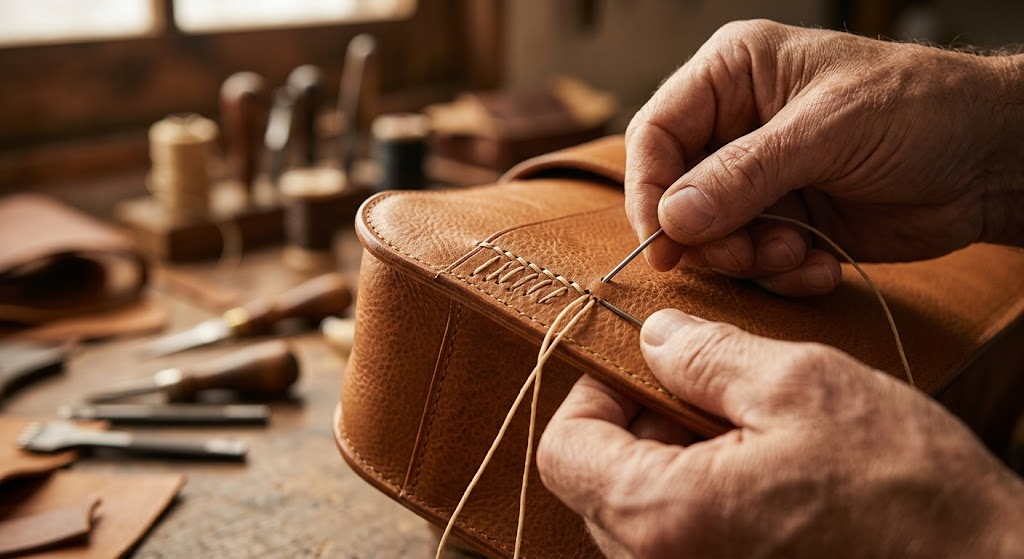
A traditional saddle stitch is executed entirely by hand using a single continuous length of heavily waxed linen thread fitted with a blunt needle at each end:
- The artisan marks the stitch line and punches clean, slanted diamond-shaped holes through the leather using a hand-forged pricking iron or an awl.
- Both needles pass completely through the same hole from opposite sides, looping over each other in an intricate figure-eight knot.
- The artisan pulls both ends tight with calibrated, identical hand tension before moving to the next hole.
The structural consequence of this architecture is profound. If a hand-sewn saddle stitch is abraded and one thread breaks, the opposing thread remains securely anchored through the diamond hole, held tightly by the internal friction knot and the dense collagen matrix. The seam cannot unravel.
By contrast, standard industrial sewing machines utilize a lockstitch, which employs two separate threads: an upper needle thread and a lower bobbin thread that intertwine inside the center of the leather hole. If a machine lockstitch breaks at any single point along a stress line, the tension instantly collapses, and pulling on the loose thread causes the entire seam to rapidly unravel like a zipper.
+--------------------------------------------------------------------------+
|                  HOW TO SPOT GENUINE HAND SADDLE STITCHING               |
+--------------------------------------------------------------------------+
|  • Characteristic Slanted Angle: Stitches sit at a crisp, elegant 45°    |
|    slanted angle on BOTH the front and back faces of the leather panel.  |
|  • Organic Tension Variations: Microscopic, beautiful variations in      |
|    depth and tension that indicate human execution rather than a motor.  |
|  • Cast and Knot Profile: The thread sits slightly proud of the surface  |
|    with a subtle, protective wax sheen that repels water and grit.       |
|  • Machine Mimicry Flaw: Machine stitching is typically straight and     |
|    flat on the reverse side, lacking the dual-sided slanted geometry.    |
+--------------------------------------------------------------------------+
Thread Quality: Waxed Linen vs. Bonded Polyester
The composition of the thread itself speaks volumes about a brand’s dedication to longevity:
- Waxed Linen Thread (Fil Au Chinois): The historical choice of haute maroquinerie. Spun from natural flax fibers and coated in pure beeswax, high-grade linen thread resists rotting, locks firmly into the leather grain, and softens gracefully over time.
- Bonded Nylon and Polyester Threads: Modern luxury industrial manufacturers frequently use continuous-filament bonded polyester or nylon threads (such as Serafil). While synthetic threads offer exceptional tensile break strength and resistance to UV degradation, they must be heat-melted at seam terminations rather than back-stitched and tucked, sometimes leaving unsightly melted plastic nodules on structural corners.
Stitch Density and Tension Calibration
Examine the number of Stitches Per Inch (SPI). High-end small leather goods (wallets, cardholders, watch straps) typically showcase a refined stitch density of 8 to 11 SPI, reflecting micro-precision craftsmanship. Larger structural items, such as heavy briefcases and luggage, utilize a sturdier 5 to 7 SPI to avoid over-perforating and weakening heavy-gauge hides.
Look closely for stitch puckering. If the leather around the stitch holes is pulled so tightly that the leather gathers, ripples, or tears, the maker used improper tension settings. Conversely, if the stitches sit loosely in the holes, dirt, water, and abrasive grit will enter the inner core of the product, causing internal rot.
Edge Finishing and Interior Anatomy: The Hidden Secrets of Craftsmanship
Mass-market manufacturers frequently invest in attractive exterior panels while aggressively cutting costs on internal structures and edge seals, knowing that casual buyers rarely inspect the interior construction of a luxury piece. A true leather connoisseur always inspects the edges, linings, and internal reinforcement boards before evaluating the exterior.
RAW CUT EDGE                     PAINTED / LACQUERED EDGE          BEVELED & BURNISHED EDGE
+-----------------------+        +-----------------------+        +-----------------------+
|  Grain Layer          |        |  Thick Latex/Rubber   |        |  Smooth, Rounded Arc  |
|-----------------------|        |  Polymer Casing Seal  |        |  Friction-Melted Wax  |
|  Exposed Fibers & Gap |        |-----------------------|        |  Natural Wood Slicker |
|-----------------------|        |  Hidden Cavity        |        |-----------------------|
|  Lining Layer         |        |  Delaminates / Cracks |        |  Fused Solid Edge     |
+-----------------------+        +-----------------------+        +-----------------------+
[ Cheap Mass Production ]        [ Standard Designer Wear ]       [ Master Artisanal Standard ]
The Three Methods of Edge Finishing
- Raw Cut Edges: The quickest, cheapest method. The leather panels are simply sheared with a blade and stitched together, leaving the porous internal corium fibers completely exposed to air, rain, and body oils. Within weeks, the exposed edges fray, absorb moisture, swell, and split apart.
- Edge Painting (Edge Inking): The ubiquitous standard in modern luxury fashion. Raw edges are sanded, coated with a colored water-based polymer or polyurethane edge paint, dried, sanded again, and re-coated in a cycle repeated between 3 and 7 times.
- The Test of Excellence: A masterfully painted edge is completely flat, smooth, and free of air bubbles or drips, feeling seamless to the touch.
- The Cheap Shortcut: Mass-market brands apply a single, thick, rubbery coat of low-grade latex paint that feels like gummy plastic. Under temperature fluctuations and bending, low-grade edge paint rapidly dries, cracks, and peels off in long, unsightly rubber strips.
- Beveled, Burnished, and Wax-Sealed Edges: The gold standard of traditional vegetable-tanned craftsmanship. The artisan rounds the sharp corner of the leather using an edge beveling blade, moistens the exposed fibers with natural gum tragacanth or water, and vigorously rubs the edge using a grooved hardwood slicker (such as dense rosewood or ebony).
- The Result: The intense heat generated by manual friction permanently fuses the natural collagen fibers into a glassy, smooth, dark, and resilient edge. The artisan then seals the edge with pure beeswax or paraffin, buffing it to a durable finish that will never peel, flake, or crack.
+--------------------------------------------------------------------------+
|                       INTERNAL LINING COMPARISON                         |
+--------------------------------------------------------------------------+
|  HEIRLOOM CRAFT: Full-Grain Suede or Nappa Leather Lining                 |
|  • Extends the operational lifespan of the product indefinitely          |
|  • Provides continuous structural support from within                    |
|  • Zero risk of tearing, fraying, or disintegrating over decades         |
|--------------------------------------------------------------------------|
|  INDUSTRIAL LUXURY: Microfiber or Heavy Woven Cotton Twill               |
|  • Highly functional, durable, and lightweight                           |
|  • Breathable and gentle on delicate accessories or electronics          |
|  • A respectable modern luxury standard when properly stitched           |
|--------------------------------------------------------------------------|
|  FAST FASHION CUT: Thin, Glued 100% Synthetic Polyester or Rayon         |
|  • Tears, shreds, and pulls away from interior seams under light stress  |
|  • Conceals structural paperboard or toxic glue composites underneath     |
|  • Traps moisture, generating foul internal odors over time              |
+--------------------------------------------------------------------------+
Hardware, Structural Reinforcements, and Architectural Integrity
A luxury leather bag, briefcase, or jacket is an architectural machine subject to continuous mechanical stress, friction, and environmental wear. High-grade leather can last a century, but if the hardware snaps, zippers seize, or internal reinforcements collapse, the product becomes unusable. Discerning buyers scrutinize the metallic components and internal skeleton just as thoroughly as the hide itself.
                      +-----------------------------------------+
                      |   HARDWARE & ARCHITECTURAL CHECKLIST    |
                      +-----------------------------------------+
                                           |
         +---------------------------------+--------------------------------+
         |                                                                  |
[ METALLIC HARDWARE ]                                           [ INTERNAL SKELETON ]
  • Solid Forged Brass / Stainless Steel                          • Vegetable Leather Reinforcements
  • Substantial weight, cool touch, unplated                       • High-Density Salpa / Bonded Leatherboard
  • Screwed / Hand-Riveted Anchor Points                           • Zero Cardboard, Chipboard, or Sponge
  • Smooth, Milled-Tooth Excella Zippers                          • Multi-Layered Load-Bearing Handle Cores
The Metallurgy of Luxury: Solid Brass vs. Hollow Zinc Alloys
When assessing luxury hardware, weight and material composition are paramount:
- Solid Forged Brass and Stainless Steel: Exceptional luxury leather houses utilize solid sand-cast or forged brass, stainless steel, or aerospace-grade aluminum hardware. Solid brass is dense, heavy, cool to the touch, and naturally rust-proof. Even if scratched during travel, solid brass does not peel or reveal an unsightly silver base; it simply oxidizes with a rich, historic golden luster.
- Hollow Zamak (Zinc-Aluminum Die-Casting Alloys): Commercial brands routinely utilize cheap, injection-molded zinc alloys electroplated with a microscopically thin brass, gold, or nickel film. This hardware feels suspiciously lightweight, hollow, and warm like plastic. Within months of friction against buckles or rings, the thin gold electroplating wears away, exposing a dull, grayish-white pot metal base underneath that easily snaps under heavy loads.
Zipper Mechanics: Stamped vs. Individually Milled Teeth
Zippers endure tremendous friction and tension over the lifespan of a leather good.
- Standard Grade: Stamped-metal or spiral nylon coil zippers feature sharp, stamped-sheet teeth that feel scratchy, catch on delicate lining fabrics, and frequently jam or separate.
- Luxury Standard: Connoisseurs look for luxury-tier zippers from premier manufacturers such as YKK Excella, Raccagni, or Lampo. In these luxury zipper lines, every individual metal tooth is precision-milled, beveled, and mirror-polished before being individually affixed to an ultra-dense woven cotton-poly tape. The slider moves with liquid, whisper-quiet smoothness that will not scratch your hands or snag your garments.
+--------------------------------------------------------------------------+
|                  THE ANATOMY OF A LUXURY LEATHER HANDLE                  |
+--------------------------------------------------------------------------+
|  The handle of a luxury briefcase or weekender represents its most       |
|  vulnerable structural intersection. A master artisan constructs a       |
|  handle like a suspension bridge:                                        |
|                                                                          |
|  1. THE CORE: Layers of dense, vegetable-tanned leather splices molded   |
|     together—NEVER cheap hollow plastic tubing, foam, or paper rope.     |
|  2. THE CASING: Premium full-grain calfskin carefully skived, wrapped,   |
|     and hand-burnished around the leather core.                          |
|  3. THE ANCHOR: Base loops secured through the main body panels with     |
|     solid brass split-rivets, backed on the interior by internal         |
|     leather reinforcement washers and cross-box saddle stitching.        |
+--------------------------------------------------------------------------+
The Ultimate Buyer’s Forensic Audit: Checklist and Red Flags
When evaluating a leather investment piece in an atelier, department store, or vintage boutique, methodically execute this comprehensive diagnostic audit.
+--------------------------------------------------------------------------+
|             THE 10-POINT LUXURY LEATHER FORENSIC AUDIT TABLE             |
+--------------------------------------------------------------------------+
| Diagnostic Check        | PASS (High-Grade Luxury)    | FAIL (Low-Grade / Faux)  |
+-------------------------+-----------------------------+--------------------------+
| 1. Scent Test           | Sweet, woody, earthy, clean | Pungent plastic/glue     |
| 2. Surface Pores        | Asymmetrical, visible pores | Painted smooth, stamped  |
| 3. Thumb Press (Break)  | Fine, organic skin wrinkles | Rigid buckle, blanching  |
| 4. Thermal Touch        | Warms quickly to palm heat  | Cold, slick, synthetic   |
| 5. Stitching Geometry   | Slanted, thick waxed thread | Straight, thin lockstitch|
| 6. Edge Finishing       | Smooth burnish or clean ink | Rubbery, peeling latex   |
| 7. Interior Lining      | Suede, nappa, or heavy twill| Fragile glued polyester  |
| 8. Hardware Weight      | Heavy, solid forged brass   | Light, hollow pot metal  |
| 9. Handle Structure     | Solid leather core, riveted | Hollow vinyl, stapled    |
| 10. Labeling Integrity  | Specific tannery & grain tier| Generic "Genuine Leather"|
+-------------------------+-----------------------------+--------------------------+
Critical Red Flags to Avoid
- Vague Labeling: Beware of items stamped simply with “Genuine Leather,” “Real Leather,” or “Engineered Leather.” True luxury manufacturers proudly state the exact grain classification and tannery provenance on their documentation (e.g., “Full-Grain French Calfskin, Vegetable-Tanned in Tuscany”).
- Chemical and Solvent Fumes: If opening the dust bag or box releases an overpowering wave of solvent fumes or chemical adhesives, the item has been constructed using toxic binders and synthetic sealants.
- Visible Glue Squeeze-Out: Check the interior seams, pocket dividers, and strap anchors. In luxury craftsmanship, contact adhesives are applied with surgical precision; visible glue squeeze-out or sticky seam gaps indicate rushed, low-grade factory assembly.
- Painted Backsides: If an unlined product features a backside painted in a thick solid color rather than showcasing natural, clean, velvety suede fibers, the maker is actively concealing a damaged, low-grade split layer.
Longevity, Preservation, and the Art of Patina
Acquiring an authentic, high-grade leather piece is merely the first chapter in a decades-long relationship. Proper care ensures the hide retains its structural integrity, resists environmental degradation, and matures into an irreplaceable heirloom.
                        +----------------------------+
                        | THE LEATHER CARE PROTOCOL  |
                        +----------------------------+
                                      |
         +----------------------------+----------------------------+
         |                                                         |
[ ROUTINE MAINTENANCE ]                                    [ CRISIS INTERVENTION ]
  • Horsehair Brush Dusting (Weekly)                         • Water Exposure: Air dry naturally
  • Pure Lanolin/Waxes Conditioner (Quarterly)                 away from radiators & direct heat
  • Microfiber Cloth Buffing                                 • Deep Stains: Specialized leather cleaner
  • Breathable Cotton Dust Bag Storage                         (Never use alcohol, solvents, or soaps)
The Three Golden Rules of Leather Care
- Rule 1: Never Starve, Never Suffocate: Leather is an organic, porous material that requires moisture balance. Condition high-grade leather 2 to 4 times per year with a natural, wax-and-oil-based conditioner (such as Saphir Médaille d’Or or pure neatsfoot oil compound). Never coat luxury leather in synthetic petroleum jellies or silicones, which clog pores and permanently prevent natural breathability.
- Rule 2: Respect Thermal Dynamics: If your leather briefcase or jacket gets caught in a torrential downpour, never force-dry it using hair dryers, space heaters, or radiators. Rapid artificial heating strips the hide of its essential internal fats, causing irreversible hardening, cracking, and shrinkage. Stuff the item with absorbent, unprinted paper and let it air-dry slowly at room temperature.
- Rule 3: Store in Breathable Cotton: Never store fine leather goods in sealed plastic tubs or non-breathable vinyl bags. Deprived of air circulation, trapped humidity encourages mold and fungal blooms, while dry environments cause the collagen fibers to desiccate. Store your pieces in breathable 100% cotton dust bags in a cool, dark, well-ventilated wardrobe.
Conclusion
The pursuit of authentic, high-grade leather goods is ultimately a celebration of patience, human mastery, and timeless material integrity. In an era dominated by fleeting fashion trends and planned obsolescence, a masterfully crafted, full-grain leather piece stands as a steadfast declaration of personal style and intentionality. It is one of the very few possessions you can acquire today that does not decline the moment you bring it home; instead, it enters into a lifelong partnership with you, recording every journey, climate, and memory across its evolving, hand-burnished patina.
By mastering the sensory forensics of luxury leatherwork—understanding the biological primacy of full-grain hides, demanding the time-honored alchemy of vegetable tanning, insisting upon the structural permanence of hand saddle stitching, and refusing the shortcuts of hollow hardware and painted-over flaws—you insulate yourself against market illusions. You become not merely a luxury consumer, but a true connoisseur of the craft.
At Royal Fashion Tech, we champion this elevated convergence of heritage artistry, structural excellence, and discerning lifestyle curation. When you invest in exceptional leather goods, choose pieces crafted with uncompromising passion, honor their journey through thoughtful maintenance, and wear them with pride as they evolve alongside your personal narrative.
Frequently Asked Questions
1. What is the single best way to distinguish real full-grain leather from synthetic faux leather?
Examine the pore structure and perform the tactile thermal test. Real full-grain leather features an asymmetrical, organic distribution of microscopic pores and rapidly warms to your hand’s body heat. Synthetic faux leather (PU or PVC) displays a mathematically repeating, stamped pattern, feels persistently cold and slick to the touch, and often emits a faint chemical or plastic odor.
2. Why is “Genuine Leather” often considered a red flag by luxury experts?
While technically containing real animal fibers, “Genuine Leather” is an industry term for split leather derived from the weakest, bottom fibrous layer of the hide (the corium). It lacks natural grain and structural strength, requiring synthetic plastic lamination and embossing to look presentable, and typically cracks or delaminates within a short period.
3. Does vegetable-tanned leather require more maintenance than chrome-tanned leather?
Yes. Vegetable-tanned leather is tanned with natural plant barks and lacks synthetic chemical sealants, making it more susceptible to water spotting and initial surface marks. However, it naturally absorbs conditioning creams and develops an extraordinary, highly coveted patina that chrome-tanned leather cannot achieve.
4. How can I tell if a luxury bag is hand saddle-stitched or machine-sewn?
Hand saddle-stitching displays a distinctive 45-degree slanted angle on both the front and reverse sides of the seam, accompanied by subtle, beautiful human tension variations. Standard industrial machine lockstitching is typically straight and flat on the reverse side and lacks the double-sided slanted geometry.
5. Why do master craftsmen prefer solid forged brass hardware over alloy hardware?
Solid brass is dense, robust, and rust-proof. When subjected to wear, scratches, or friction, solid brass maintains its golden tone and develops an attractive antique patina. In contrast, hollow zinc alloys (Zamak) use thin electroplating that wears away, exposing cheap gray pot metal that easily breaks under stress.
6. Can real luxury leather be completely scratch-resistant?
Heavily treated leathers with embossed surfaces (like Saffiano or Epsom) offer excellent scratch resistance due to protective resin topcoats. However, natural untreated full-grain leathers will show light surface marks; on high-grade, oil-rich pull-up hides, these surface scuffs can easily be buffed out using a horsehair brush and the natural heat of your thumb.
7. What does a “burnished edge” mean, and why is it superior to edge paint?
A burnished edge is created by rounding the raw leather edge and rubbing it vigorously with a wooden tool and natural waxes. The friction heat permanently fuses the organic collagen fibers into a glassy, smooth, dark seal that can never crack or peel off, unlike low-grade synthetic edge paints.
8. How often should I apply leather conditioner to my luxury goods?
Under normal usage, conditioning your leather goods 2 to 4 times a year is ideal. Over-conditioning can saturate the collagen matrix and make the leather excessively soft or structurally weak, while under-conditioning allows the natural fibers to dry out, leading to surface cracking.